

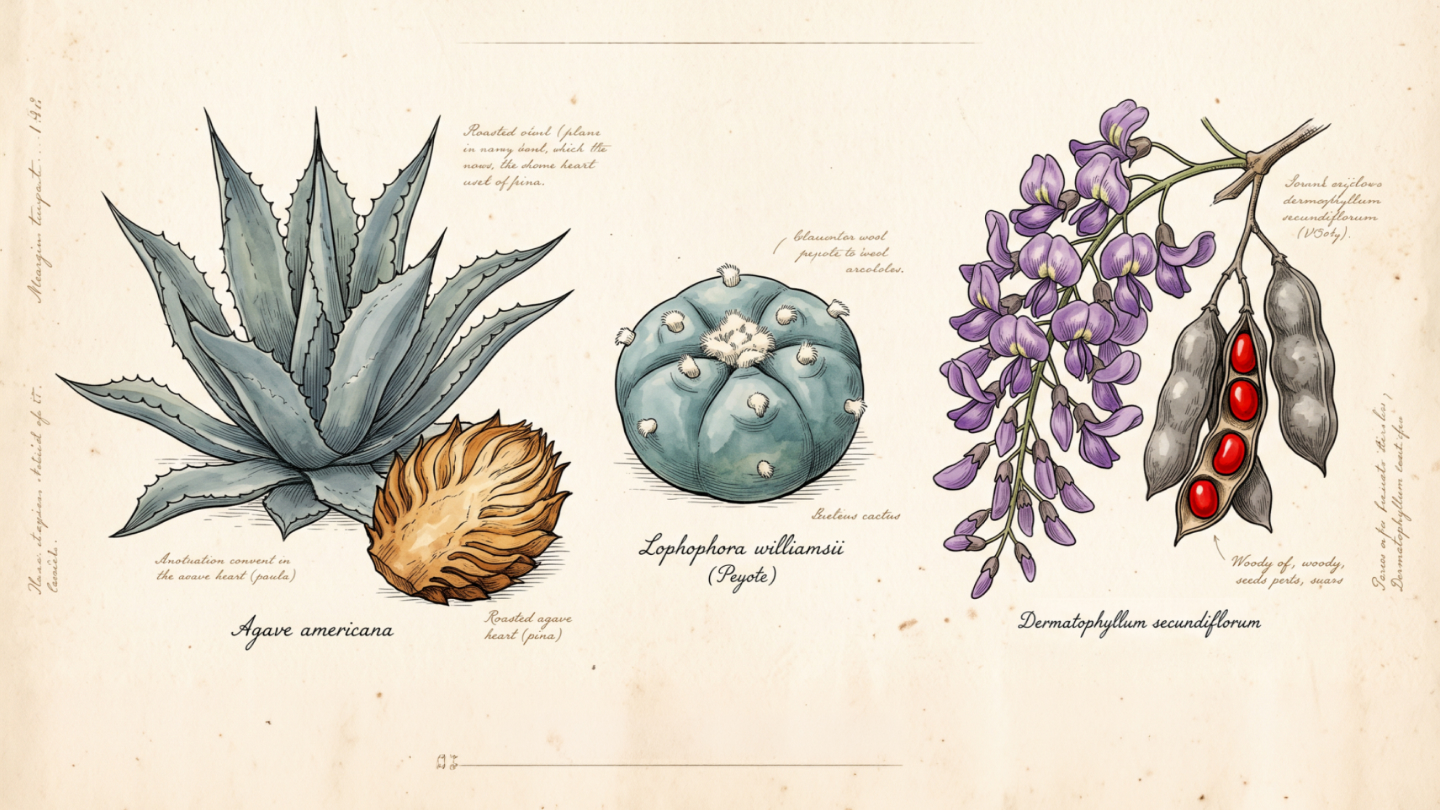
Most people hear “mescal” and think of a fiery distilled drink. That is correct, but it is only a third of the story. Over roughly four decades, the same name was attached to three unrelated plants: a succulent, a cactus and a legume, and untangling how that happened turns out to be a case study in how science, journalism and politics can collectively lose track of what they are talking about.
The original mescal was a cooked agave
The first plants called “mescal” and “the mescal plant” were Agave species, known today as maguey or, in English, the century plant. This is the original mescal, and the etymology is unambiguous. The word descends from the Nahuatl mexcalli, combining metl (agave) with either ixcalli (stew) or ixca (to bake), giving roughly “cooked agave.” Since antiquity the hearts of the maguey, meaning the bases of the stems, were roasted in earth ovens to make an important sugary food (Castetter, 1935). Those same cooked hearts supplied the sugars for fermented drinks and, after the Spanish invasion, for the distilled liquor now spelled mezcal (Bruman, 2000).
The name travelled beyond the plant. Spanish colonists routinely named Indigenous peoples after a characteristic food rather than by the names those peoples used for themselves, and several groups were labelled by their habit of roasting the mescal plant: the Mescales in Coahuila by 1760, a Coahuiltecan-language group known as the Mescalero by 1691, the Mescalero Apache by 1724.
One point matters for everything that follows: agaves do not produce beans. Only leguminous plants do. So the phrase “mescal bean” cannot originally have referred to an agave. Trout traces its earliest locatable appearance to an 1854 satirical review in the Grand River Times of an imaginary symphony, a parody of critics who claimed to hear whole landscapes in an orchestra. A clarinet supplies the longitude, the bass drum the horizon, and a few notes on the piccolo, the reader is told, call attention to “a solitary antelope, picking up mescal beans in the foreground.” The spoof was reprinted in American newspapers for decades. That antelope cannot have been eating anything real: not an agave or yucca, which bear no beans; not the cactus, which would not carry the name until 1888; not the red bean, which acquired it a few years after that. The phrase entered the language attached to nothing at all.
“While temperance refers to the use of personal self-control to limit intoxicant ingestion, the goal of a prohibitionist is instead achieving legislation to implement their religious ideology through force of law by declaring what they consider sins to be crimes.“
— Keeper Trout, ESPD50
How a cactus acquired the name
The second claimant was Lophophora williamsii, a small spineless cactus of south Texas and northern Mexico. It already had a perfectly serviceable name. Spanish chroniclers had been writing peiotl, peyotl and then peyote since the sixteenth century, from the Nahuatl, and those names appear steadily in print through the 1800s. Then, for a few decades beginning in the 1880s, American sources abruptly started calling it mescal.
The sequence is tight. Briggs used “muscale buttons” in 1887, followed by Lewin and Hennings in 1888. E. E. White wrote “mescal bean” that same year, sourcing the term from white settlers in Oklahoma. James Mooney used “mescal” and “the mescal plant” between 1891 and 1893, apparently having heard it from a Kiowa friend while researching Kiowa calendar history. Prentiss and Morgan wrote “mescal buttons” in 1895.
The most consequential step came in 1894. Arthur Heffter judged “muscale” to be improper Spanish and, because the material was understood to be intoxicating, “corrected” it to mezcal. From that he coined mezcaline. The name of the best-known cactus alkaloid, still in use today, therefore derives from a word for distilled agave liquor, and encodes a nineteenth-century assumption that the cactus was an intoxicant of the same family as alcohol.
Genuine ignorance accounts for part of this. Parke, Davis & Company distributed dried material to several prominent researchers as “muscale buttons” without initially realising it was a dried cactus at all. Trout suggests a “tastes like chicken” effect, in which people reach for the nearest familiar reference to describe something genuinely novel. The confusion has proved durable: as recently as 2017 an online dictionary still described the “mescal cactus” as a source of psilocybin, and a university substance-abuse centre called mescaline an amphetamine.
Manufacturing an intoxicant
The rest of the confusion was not accidental. Trout’s central argument is that renaming the cactus as a “mescal” served a purpose. Prohibitionists, many of them Christian reformers whose programme included eliminating traditional Indigenous religions, saw clear political value in the plant being perceived as an intoxicant and its ceremonial use as a pretext. Alongside the misnomer came a whole vocabulary: Indian dope, the dope bean, the jag bean, the drunk bean, whiskey root, dry whiskey.
The press did the rest. Newspapers of the period described the material as containing opium and cocaine, or likened its effects to a highball of cocaine and whiskey with a dash of champagne. In 1906 a syndicated story ran across the United States announcing that the Winnebago faced extinction within a few years; several Protestant women’s groups declared a “War on Mescal” the same year. A persistent urban legend that the plant’s central tuft of hairs is the most potent or most toxic part, and that smoking it induces immediate insanity, traces directly to prohibitionist news copy from 1918.
Official language was frequently candid about the real objection. Commissioner of Indian Affairs Robert G. Valentine wrote in his 1911 annual report that even if the physiological effects were not serious, use would still have to be prohibited for the same sociological reasons that had led the government to modify Indian dances. James Mooney, assigned by the Bureau of Ethnology to study the peyote religion, defended its legitimacy before Congress and was recalled from Oklahoma for doing so.
The red bean joins the confusion
The third plant is the Texas mountain laurel, Dermatophyllum secundiflorum, a legume that genuinely does produce a hard scarlet seed. Earlier writers who knew it called it coral bean, poison bean, frijolillo, frixolillo or frijolito. It picked up the name mescal bean only after the cactus had, apparently around the time of Hugh Lennox Scott’s Fort Sill ledger notes of 1889 to 1897.
Legislators promptly wrote the muddle into law. Oklahoma’s 1899 session laws outlawed “Mescal Bean” without ever defining the phrase. Kansas went further: in 1920 it passed an act whose own title named both Lophophora williamsii and “Agava [sic] americana (commonly known among the Kansas Indians as mescal),” banning two entirely unrelated plants in a single sentence and misspelling one of them. Arizona and South Dakota enacted almost identical laws in 1923, and the Dodge City municipal code was still echoing the same wording in 2014.
This was not for want of correction. In August 1907 Special Agent R. S. Connell explicitly drew his colleagues’ attention to the difference between the two plants, and that same year Quanah Parker testified to Oklahoma’s constitutional convention Medical Committee that the beans were poison and peyote a different thing entirely, an herb transmitted from Mexican Indians to the Lipan Apache, then to the Comanche and Kiowa. A number of authorities carried on regardless.
The record shows the two plants were not interchangeable to the people who used them. Merrill (1977) found that more than forty groups knew the red bean but fewer than half ingested it, and that its documented uses ran to a contradictory spectrum: stimulant for dancing, purgative, soporific, war medicine applied topically, horse medicine, and beads. Bandoliers of the beans were highly prized, including by peyote leaders, which is a use that does not involve eating them at all. Garcia’s bilingual confessional of 1760 asks separately about eating peyote and about eating the frixolillo, treating them as distinct.
What the Shumla Cave artifacts really are
A 1976 paper by Adovasio and Fry proposed that psychotropic plant use in the region followed an orderly path from more toxic to safer choices: Mexican buckeye (Ungnadia speciosa) giving way to the red bean, which was in turn replaced by peyote. The hypothesis has been widely repeated as established fact. Trout argues it does not survive contact with the evidence.
The oldest site reported only the red bean, and no site yielded buckeye alone. The single Lophophora example sat at the youngest date, although other ancient specimens were known and simply not dated. Schuetz had noted in 1963 that peyote and the red bean occurred together in the Shumla Caves, suggesting overlapping rather than sequential use, a point Adovasio and Fry were aware of and omitted. As Trout observes, soft cactus tissue is unlikely to survive as well as a hard seed, which is a far simpler explanation than replacement.
The Shumla material itself held a genuine surprise. Terry and colleagues (2006) established that the surviving specimens are not cactus crowns at all: under magnification there are no ribs, no areoles, no vascular structures. They were manufactured, shaped from a dough with a random fibrous internal composition, incorporating what is assumed to be peyote based on reported mescaline content, and formed to represent a crown cut at ground level. Radiocarbon dating placed them in two distinct periods within 4200 to 3950 BC, meaning at least two makers separated by several human generations.
A lethal reputation nobody can document
The premise underneath the replacement hypothesis was relative toxicity, and that premise is also shakier than it looks. Trout reports being unable to verify a single human death from ingesting either the red bean or Mexican buckeye seeds in the medical or morbidity literature. What exists for the red bean is early anecdote; for Ungnadia, essentially nothing.
The chain of citation is instructive. Dayton wrote in 1931 that children had been known to die from the seeds and that one was said to suffice to kill an adult, referencing Havard (1896), whose account was itself a misquotation of an anecdote in Wood (1877) about a single frijolillo. Wood did not mention children. That unverified assertion then propagated: Schultes repeated in 1937 that the drink was highly toxic and often fatal, without indicating how often or citing a source, and Gottlieb was still warning in 1973 that a little too much may cause convulsions and death.
The chemistry does not obviously support the reputation either. Cytisine, the bean’s principal alkaloid, is a partial nicotinic agonist and could certainly be fatal at a large enough dose, but reported content varies wildly across the literature, from 0.25 percent to over 9 percent. Cytisine is meanwhile available in pure form as a smoking-cessation aid, approved for human use since 1965. Merrill concluded that the primary documented applications were emesis, purging and perhaps stimulation, and that there is no evidence the alkaloids can induce hallucinations at all.
Trout draws a distinction worth keeping. All poisonings may correctly be called intoxications, but it is misleading to call all poisons intoxicants: people choose intoxicants for their effects, whereas poisons are usually encountered by accident. Three plants were merged under one name precisely because that distinction was not
Frequently asked questions
What does the word “mescal” actually mean?
It comes from the Nahuatl mexcalli, combining metl (agave) with either ixcalli (stew) or ixca (to bake), giving roughly “cooked agave.” The word originally described the roasted hearts of maguey plants eaten as food, and had nothing to do with any cactus or bean.
Is mescal the same thing as mezcal, the drink?
They are the same word. Early Hispanophone writing spelled the loanword “mescal”; as it gained wider use the spelling shifted to the current “mezcal.” The distilled spirit is made from the cooked agave hearts that gave the word its meaning in the first place.
What is a mescal bean?
Today it usually means the hard red seed of Dermatophyllum secundiflorum, the Texas mountain laurel, also called coral bean or frijolillo. Confusingly, the same phrase was applied to a spineless cactus in 1888, several years before it attached to the actual bean, and it appears to have been coined in 1854 in a satirical newspaper piece where it referred to nothing real at all.
Why was peyote called “mescal”?
Trout identifies two non-exclusive reasons. One is ordinary confusion, with people reaching for a familiar reference to describe something unfamiliar; Parke, Davis & Company distributed the dried material without initially knowing it was a cactus. The other is deliberate: prohibitionists gained politically from the plant being perceived as an intoxicant comparable to alcohol.
Where does the word “mescaline” come from?
Arthur Heffter coined it in 1894. He judged the then-current “muscale” to be improper Spanish and corrected it to mezcal, the agave liquor, on the basis that the material was an intoxicant. The alkaloid’s name therefore derives from a distilled drink and preserves a nineteenth-century assumption about what the cactus did.
Has anyone ever died from eating a mescal bean?
Trout was unable to locate any verified human fatality in the medical or morbidity literature. The widely repeated claim that a single seed can kill an adult traces back through Dayton (1931) and a misquotation of Havard (1896) to an anecdote in Wood (1877). Cytisine, the bean’s principal alkaloid, could be dangerous at sufficient dose, and this article is historical rather than a safety assessment.
Are the Shumla Cave peyote specimens real peyote buttons?
No. Terry and colleagues established in 2006 that they are manufactured effigies. They show no ribs, areoles or vascular structures, and were shaped from a dough with a fibrous binder to represent a cactus crown cut at ground level. Radiocarbon dating placed the three survivors in two periods within 4200 to 3950 BC.
Did prohibition-era claims about peyote have any scientific basis?
The claims circulating in the press were largely unsupported, including assertions that the material contained opium and cocaine or caused immediate insanity when smoked. Official statements were often explicit that the objection was religious and sociological rather than pharmacological, and the anticipated population of “peyote addicts” provided for at the federal Narcotic Farms in 1929 never materialised.

Keeper Trout
Self-taught ethnobotanist, scholar and photographer – Co-founder, Cactus Conservation Institute
Keeper Trout is the author of the Trout’s Notes series of ethnobotanical references and a former technical editor of The Entheogen Review. He is a co-founder and board member of the Cactus Conservation Institute and a board member of the Chihuahuan Desert Preserve Association, and is active in the Shulgin Archives Project. With Dr. Martin Terry he has co-authored long-term field studies on the effects of repeated harvesting on wild Lophophora williamsii populations in south Texas, published in the Journal of the Botanical Research Institute of Texas. He presented this research at ESPD50 in 2017.
Mescal, Peyote and the Red Bean: A Peculiar Conceptual Collision in Early Modern Ethnobotany – ESPD50
Keeper Trout · 1 hr · McKenna Academy
McKenna Academy · Living Library
Study ethnobotany with the people who built the field


