Psychedelics · Ethnopharmacology · History
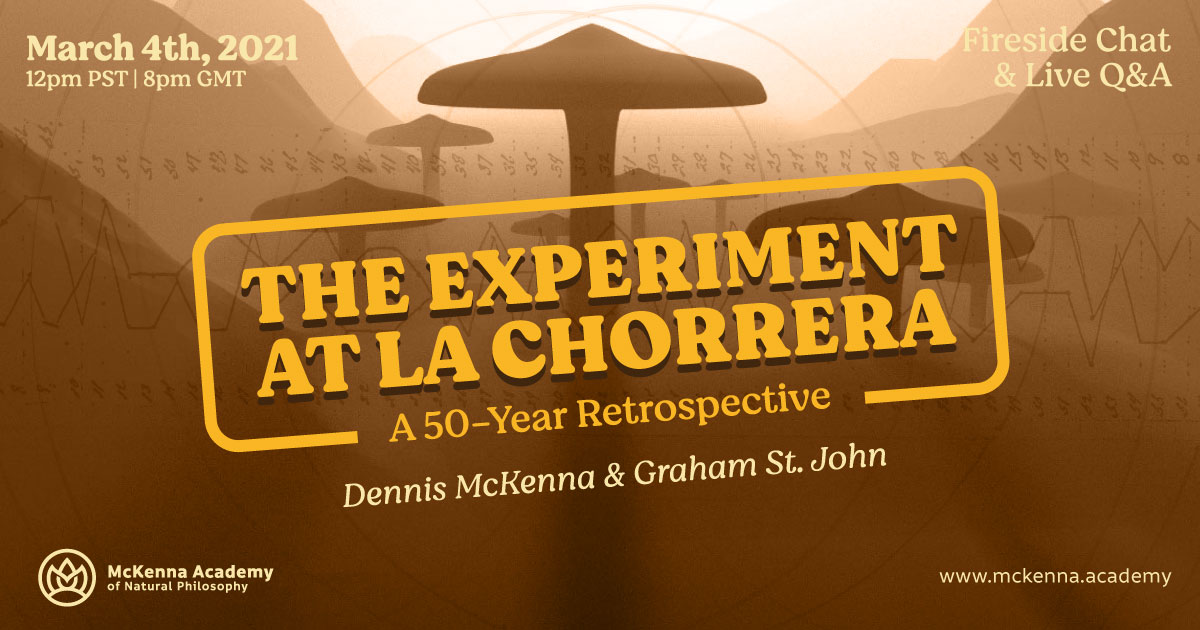
In February 1971, Dennis and Terence McKenna travelled to La Chorrera, a remote settlement in the Colombian Amazon, in pursuit of an obscure orally active DMT preparation. What they found instead, Psilocybe cubensis growing from cow pies in a mission pasture, would change the direction of both their lives, plant the intellectual seeds of the Stoned Ape Theory, and haunt the counterculture for fifty years.
The fall of 1970 was a difficult year for my brother and me. Our mother died on October 25th, at the young age of 57, after a long battle with cancer. My brother Terence had been hanging out in the jungles of Indonesia, for most of the previous year collecting butterflies, keeping a low profile and trying to avoid being noticed by Interpol. Following the hash bust in India in 1969, we assumed he was a wanted man. This may or may not have been true. Eventually he made his way to Tokyo for a stint teaching English, and thence to Victoria B.C., where I visited him that fall. It was as close as he could get to our mother, who was undergoing cancer treatment in Grand Junction, Colorado. We feared that if he tried to visit her, that he would probably have been intercepted as soon as he tried to cross the border, due to the supposed bounty on his head. It enormously complicated his attempts to see her in October. That misadventure is further described in my memoir, The Brotherhood of the Screaming Abyss (2012).
For my part, I was living in Boulder at the time and was in the first semester of my sophomore year at the University of Colorado. I was busy studying botany and anthropology, enjoying hanging out with my girlfriend, one of the first serious loves of my life. In many ways it was a happy time for me, marred, of course, by our mother’s illness and the looming prospect of her imminent death. When it came in late October it was devastating, if not unexpected. It was traumatic for both Terence & me, made all the more so for Terence by the fact that he was unable to reach her in time.
The Call of the Secret
Autumn of 1970 was a significant transitional time for both of us, and marked a change in trajectory that would determine the direction of the rest of our lives. Terence and I had been exchanging correspondence over the previous two years to discuss plans and share ideas about an expedition to South America. Like many of our contemporaries, we were both immersed in the counterculture. Psychedelics were one of our preoccupations; we felt that they must be significant in some way that went beyond the rather casual way they were being used and portrayed in popular media.
Our first psychedelic encounters were facilitated by LSD in part because LSD was what was available; there was very little else. But several years prior, Terence had managed to find DMT, very rare at the time, but available if you knew the right people. Our first encounters with DMT were revelations. LSD was interesting, but this… this was weirder by orders of magnitude. DMT seemed to be more than “just another” psychedelic. Anyone who has experienced it will confirm that the effects have a consistently science-fictionish quality, replete with apparent encounters with non-human intelligences and strange machinery of uncertain purpose. The smoked DMT trip is like taking a fast ride on a neon-lit roller coaster through a hyperspatial cosmic carnival.
“That a psychedelic drug could transport one to an alien dimension — it would easily be the greatest scientific discovery.“
It seemed real enough to us. And it became important to investigate this phenomenon. We were coming to psychedelics not through traditional shamanic or spiritual practices but through conceptual lenses steeped in an eclectic stew of Jungian psychology, alchemy, ceremonial magic, Eastern mysticism and most importantly the themes and memes of science fiction. We had inherited the fondness for sci-fi from our father, long before we had ever heard of psychedelics, and it formed a sort of bedrock foundation. By the time 1970 drew to a close, we had decided it was time to get serious about pursuing this investigation. Nothing else seemed more important.
We Depart for La Chorrera
What The Secret was, exactly, was a murky concept. What did seem clear was that it had to do with DMT, and its potential power to force open a portal on an alien dimension at least as real as what we called ordinary reality. In any case, the vision was compelling enough that at the end of January 1971, we (along with three companions equally in thrall to the vision or delusion) found ourselves on a barge making its way down the Rio Putumayo, the first leg of our journey to La Chorrera.
What had brought us to La Chorrera was that it was the ancestral home of the Witoto people; and the Witoto shamans were using an interesting psychedelic called oo-koo-hey, an orally active DMT-based preparation derived from a species of Virola, a genus of trees in the nutmeg family. The sap of Virola species is rich in DMT and other tryptamines. There are good reasons to prepare it as a snuff, because DMT and related compounds are not orally active without mixing with a monoamine oxidase inhibitor. Indeed, this is the basis of ayahuasca’s pharmacology; the ß-carboline alkaloids in Banisteriopsis protect the DMT in the brew.
When we stumbled on a paper by Richard Schultes in the Harvard Botanical Museum Leaflets, titled “Virola as an orally administered hallucinogen”, we were quite excited.1 As profound as smoked DMT was, one drawback was that the duration was disappointingly short, only about 20–30 minutes. We naively thought that an oral form would metabolize more slowly and enable us to spend more time conducting a more thorough survey of this postulated other dimension.
1 Schultes, R.E. (1969) Virola as an orally-administered hallucinogen. Harvard Botanical Museum Leaflets 22, 229–240.
The Mushroom Teacher
As it turned out, oo-koo-hey was not the Secret we had imagined. What turned out to be the real Secret quickly made itself known, in the form of an abundance of Psilocybe cubensis, the pan-tropical psychedelic mushroom. In the warm seasonal rains, robust clusters of P. cubensis sprouted from nearly every cow pie in the pastures that had been cleared around the mission. We knew what the mushrooms were because we had done our homework; but our experience of their effects was almost nil, so we had no idea of their potency or the beautiful, deep psychedelic experiences they unlocked.
The mushrooms soon made it clear that they were the real Secret, and quickly reorganized our priorities. High doses seemed to provide exactly the kind of access to the tryptamine dimension that we had come to explore. The oo-koo-hey that had originally called us to La Chorrera became all but forgotten as we were sucked into the bizarre, alienesque worlds revealed by what we came to call the Mushroom Teacher.
“The Mushroom Teacher was the keeper of the Secret, and it was eager to share it with us“
The Mushroom Teacher began downloading information, mostly channeled through me, about an experiment we could perform: a psychobiological alchemical transformation using sound that would result in a fusion of mind and matter, eventually resulting in the creation of an object, both internal and external to the body, that would function as a kind of biological Philosopher’s Stone. The instructions were basic: by imitating a sound that we could detect inside our heads on high doses of mushrooms, we could affect a resonance with our DNA, which was intercalating the tryptamines and ß-carbolines circulating within us; it would shift the DNA into a superconducting state, creating a stable standing wave able to access all of the individual and phylogenetic information stored in the human species’ DNA. Or something like that.
The details were murky even then, and 50 years on, they are even more so. It doesn’t really matter because although we were enthralled by these seductive ideas, they were mostly nonsense. The instructions the Mushroom Teacher imparted were laid down with oracular authority and were not meant to be questioned, only to be followed. This psychobiological artifact, which we came to call the Eschaton, had much in common with other conceptions of super technologies that have long haunted the human collective imagination: UFOs, Time Machines, the Philosopher’s Stone, Magic Mirrors. The Eschaton was to be all of that, and much more. Our aspirations were as inflated as our manic delusions.
RELATED
The Stoned Ape Hypothesis: Psilocybin and the Origins of Human Consciousness
Dennis McKenna · May 2026 · Mycology & Psilocybin · Key Figures
The Experiment and its Aftermath
So those were our expectations, fresh from our consult with the Mushroom Teacher, as we settled into our hammocks in the early evening of March 4, 1971. We had brought in a big cluster of mushrooms from the pasture, still growing out of their cow pie; we had carefully laid out about 17 large carpophores for each of us to consume, and had prepared a decoction of Banisteriopsis vine to provide the ß-carbolines, the “secret sauce” required to complete the reaction.
What transpired during the Experiment has been thoroughly described in both True Hallucinations and The Brotherhood of the Screaming Abyss, so I won’t repeat it here.3 We performed the Experiment. It did not have the expected outcome, because what we had projected would happen could not possibly happen. Yet we had gone into the experiment unfazed by this inconvenient fact; in some ways the whole point was to destabilize the structure of the continuum, so the fact of its impossibility was viewed as a minor inconvenience to be overcome. We had backed ourselves into an uncomfortable epistemological corner.
“Reality displayed a stubborn resilience in the face of our attempts to disrupt it.”
What “gave” was our already tenuous grasp on consensus reality. Instead of witnessing the Stone materialize dramatically as a glowing, violet disk out of a cloud of ice crystals, the actual conclusion of the experiment was considerably more anticlimactic. And yet there were transient phenomena, such as when an image of the Earth, as seen from high orbit, appeared to form for a few seconds in the cap of the largest mushroom in front of us. The oracular voice of the Mushroom Teacher kept assuring us that in fact we had succeeded in condensing the Stone, but that this condensation would take place over time, not instantaneously.
As it has turned out, that assurance stretched over years, then decades. The E@LC was certainly a pivotal event in both of our lives. For many years, Terence remained convinced that we had in fact succeeded, and that the Stone would surely manifest, but when? Terence’s manipulations of the Time Wave was an attempt to hone in on this postulated end date. After many iterations the “definitive” date of December 21, 2012 was proclaimed, conveniently coinciding with the end of a major cycle in the Long Count Mayan Calendar. In the end, Dec 21st 2012 came and went, and apart from the interesting planetary alignments built into celestial mechanics, not much else went on. Sadly, Terence had been gone for 12 years when the proof, or disproof, came in.
While the Time Wave was and remains an interesting quasi-mathematical construction, I doubt that it describes the underlying structure of time. What it does do, perhaps, is provide a lens through which various expanses of time can be viewed, and since it is based on resonances, could be helpful in divining the qualia, the subjective experiences of those resonances.
3 Those who may wish to review those descriptions can consult True Hallucinations chapter 11, “The Experiment at La Chorrera,” and/or Chapter 31, also called “The Experiment at La Chorrera,” in The Brotherhood of the Screaming Abyss (2012).
The Mushroom’s Gift
The other gift we received from the Mushroom Teacher was the most valuable of all, and it was nothing supernatural at all. It was the spores of the mushrooms, which we carefully collected and brought home with us. After a couple of years of fiddling around without much success, we finally stumbled on a simple, elegant method for growing small amounts of mushrooms on sterilized rye grain in mason jars. Terence and I were both delighted at this discovery! For one thing, the violet doorway to the psilocybin hyperspace had just shimmered open. It was good to reconnect with the Mushroom Teacher after our long abstinence since La Chorrera.
But we also wanted to share the knowledge of this simple technique with the world. In 1975 we published a little book, a pamphlet really — Psilocybin: Magic Mushroom Grower’s Guide, originally published by And/Or Press in Berkeley. It seemed to be just what people were waiting for. The book took off, and over time fell into the hands of many an amateur mycologist. As a result, mushrooms became much more accessible and affordable for many people, and particularly in the post-internet era, created opportunities for people to share memes, stories, and art, effectively creating a modern psilocybin mycoculture that drew on traditional shamanic practices but also incorporated themes from science fiction and techno pop.
Wider implications of our renewed co-evolutionary alliance with the mushrooms remains to be seen. Certainly it is impacting the culture, and finally is no longer exiled from medicine. The list of therapeutic benefits of psilocybin is large, well-documented, and growing. But the future is hopeful if only biomedicine can accept the changes it will have to make to integrate psychedelic healing. The pitfalls are many, starting with corporate greed and a failure to understand that effective therapeutic use of psychedelics will require a complete restructuring of therapeutic support protocols.
“Treating everyone and all beings with respect and compassion, if we can apply that lesson alone, our species and our beautiful but wounded planet will not only survive, but will thrive and flourish.“
CONTINUE THE EXPLORATION
The McKenna Academy Living Library
Fifty years after La Chorrera, the investigation continues. The Living Library brings together Dennis McKenna, leading ethnopharmacologists, and a global community of learners to explore plant medicine, consciousness, and ecology — with the rigour and depth the subject deserves.
Further Reading
BLOG
Telluride Mushroom Festival: A Deep Dive into Mycology, Psychedelics & Community
Dennis McKenna · March 2021 · Events & Community
blog
The Stoned Ape Hypothesis: Psilocybin and the Origins of Human Consciousness
Dennis McKenna · May 2026 · Key Figures · Mycology
blog
Reflections and Remembrance of Jonathan Ott
Dennis McKenna · July 2025 · Ethnopharmacology · Key Figures
BLOG
Beyond Climate Fear and Trepidation
Wade Davis · June 2024 · Events & Community
“If we can treat everyone and all beings with respect and compassion, we will enter into a new era of human maturity and wisdom.“
— Dennis McKenna, Ph.D. · President and Principal Founder, McKenna Academy