mycology
ethnobotany
course guide
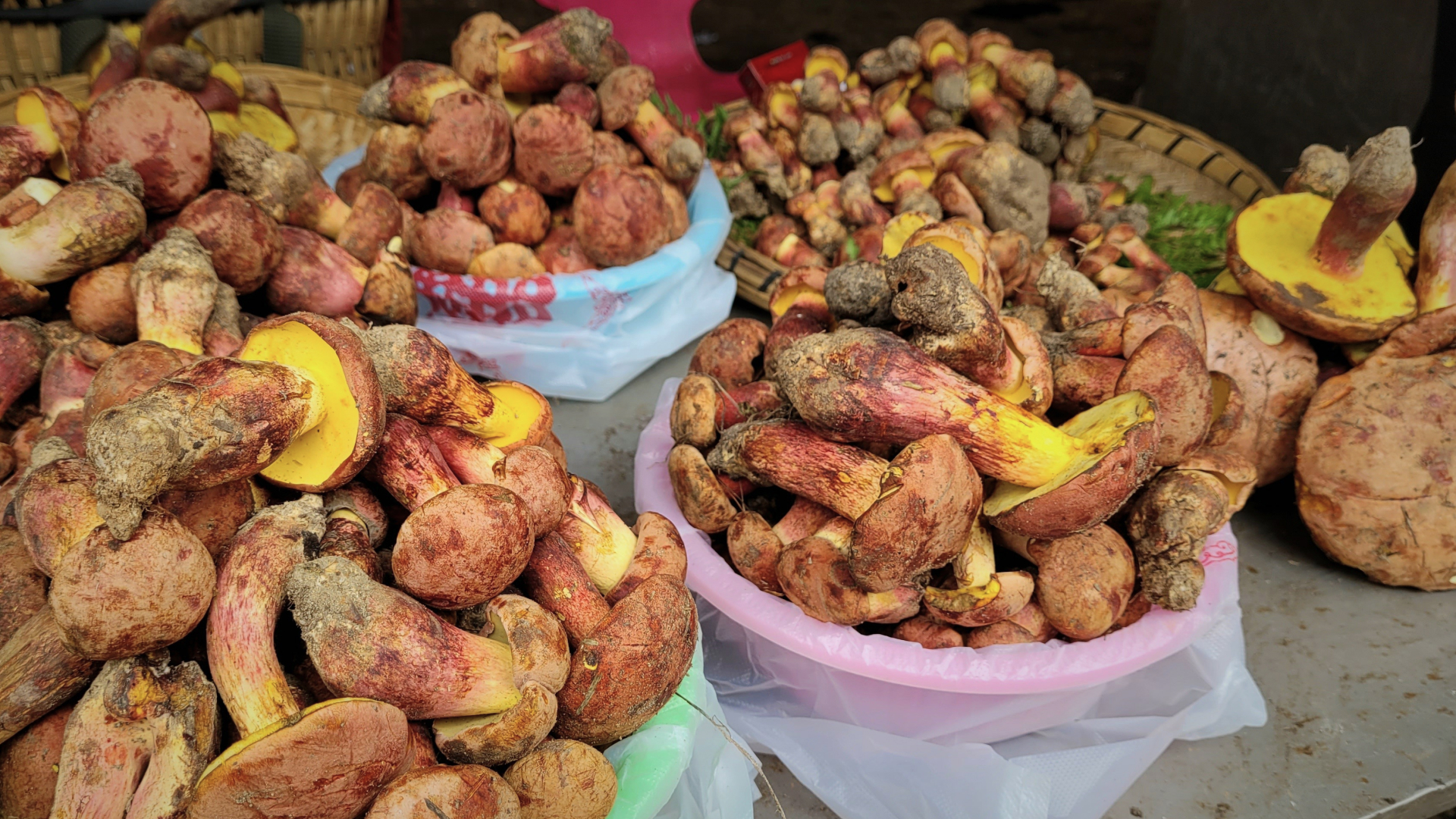
Bolete mushroom hallucinations — vivid visions of tiny people reported independently across Papua New Guinea, Yunnan, and the Philippines — are one of mycology’s most puzzling and least-studied phenomena. Colin Domnauer, PhD, an ethnobiologist at the University of Utah, has spent years on their trail. His McKenna Academy course, Lilliputian Lore, is the first systematic account of the field research, clinical data, and unsolved chemistry behind this genuinely strange chapter in psychoactive science.
in this article
Mushroom Madness: The Phenomenon That Predated Psilocybin
In 1934, a missionary living in Papua New Guinea wrote in his journal about a wild mushroom called nanda — one that, after eating, made users “temporarily insane.” Subsequent anthropologists working with the same communities documented the subjective effects in more clinical detail: Lilliputian hallucinations, visions of bush demons, double vision, and strange sounds. Later fieldwork in the early 2000s captured testimony from village elders who described seeing tiny people with mushrooms around their faces, teasing them, two centimetres tall.
What made these early reports scientifically unusual was the mushroom involved. The consensus among those who investigated it — including mycologists Gordon Wasson and Roger Heim, who traveled to Papua New Guinea in 1963 — was that it was a bolete mushroom: a family recognisable by its sponge-like pore layer rather than gills, and one that diverged from the psilocybin and Amanita mushroom lineages roughly 150 million years ago. This suggested a potential third, entirely independent origin of a psychoactive bolete in the fungal kingdom — one with a completely different chemistry.
Albert Hoffman, who had isolated psilocybin only years before, attempted to identify the active compound in specimens collected during the 1963 expedition. He found nothing, and the phenomenon was largely dismissed as cultural drama. It would stay that way for decades.
The Yunnan Resurgence and the Challenge of “Jian Shou Qing”
Starting in the 1990s, written reports of a strikingly similar phenomenon began emerging from Yunnan, China — a region with a deep tradition of wild mushroom foraging and consumption. Local people described a psychoactive bolete that, when undercooked, produced vivid Lilliputian hallucinations. A 1991 hospital review documented 300 cases in which patients reported seeing little people and animals moving across their clothes and dishes, with hallucinations described as especially vivid when eyes were closed.
The phenomenon became significant at a public health level. By the time Domnauer began his research, around 500 people per year were admitting themselves to hospital in Yunnan after consuming the mushroom. Every restaurant serving boletes had warnings posted on its walls. When US Treasury Secretary Janet Yellen ate these mushrooms during a visit to China — reportedly without hallucinogenic effect — the story briefly became a Western media event, bringing the phenomenon to international attention while the underlying science remained almost entirely unexplored.
Part of the problem was taxonomic. In Yunnan markets, more than 20 morphologically similar bolete species are sold under the same local name — jian shou qing, meaning roughly “turns blue when cut.” DNA sequencing studies found that a single local name could refer, on average, to four distinct species. Without reliable identification, studying the pharmacology of any one species was nearly impossible.
“Simply because we can’t isolate a psychoactive compound doesn’t mean that it’s not there. It could be something very different than we’re used to looking for.”
— Colin Domnauer, PhD · Ethnobiologist
Field Research Across Two Cultures: How DNA Verified the Species
Domnauer’s approach was methodologically direct. He traveled to Yunnan in 2023, went to the mushroom markets, and asked the vendors — who were entirely open about the subject — which species caused the hallucinations. He collected specimens identified by local knowledge, freeze-dried them to preserve both chemistry and DNA, and brought them back to the lab.
In 2024, a social media post led him to the northern Philippines, where a mushroom locally called Sedesdem was reported to cause visions of little people when undercooked. He traveled there, worked with local guides to identify the responsible species, and collected samples. Back in the lab, DNA sequencing of both the Yunnan and Philippines samples returned the same result: Lanmaoa asiatica.
This convergence of two independent cultural reports on a single DNA-verified species provided the first rigorous molecular evidence that the phenomenon was not a fabrication. Three cultural lineages — Papua New Guinea, Yunnan, and the Philippines — had no documented historical contact through which the knowledge could have spread. They had each arrived at the same observation independently.
What the Laboratory Has — and Has Not — Found
Domnauer’s laboratory work involved generating chemical extracts from Lanmaoa asiatica specimens, alongside extracts from Boletus edulis (a non-hallucinogenic edible bolete) as a negative control and Psilocybe cubensis as a positive control. These were administered to mice, and behavioral observations were recorded.
The results were clear: mice given the Lanmaoa asiatica extract showed pronounced hyperactivity followed by a sustained period of hypoactivity — a stupor-like state in which they did not react to touch. The behavioral signature was distinct from both controls, confirming a real bioactive effect and suggesting a mechanism different from psilocybin.
Fractional analysis — breaking the extract into progressively narrower chemical subdivisions and re-testing each in mice — narrowed the bioactive component down to a fraction containing one to three compounds. But the identity of those compounds could not be determined. Whether a single molecule or a synergistic combination is responsible, and whether the mouse bioassay reflects the same mechanism as the Lilliputian hallucinations in humans, remains an open question.
The pharmacology adds another layer of strangeness. Clinical data from Yunnan Hospital showed that 83% of patients who consumed the mushroom had hallucinations lasting one to five days — a duration far outside the range of psilocybin, which typically acts over four to six hours. No abnormalities in vital organ function were recorded, and no deaths were reported. The mushroom appears to be relatively safe, even as its mechanism defies the frameworks currently available to pharmacologists.
Ancient Lineage: The Daoist “Flesh Spirit” Mushroom
The modern scientific record of Lanmaoa asiatica‘s effects dates back only a few decades. But the cultural record may reach much further. An ancient Daoist text describes a “flesh spirit mushroom” — one associated with seeing a little person between three and thirty-three centimetres tall — and instructs that it must be consumed raw to produce the effect. “Consume it raw and you will attain transcendence immediately,” the text reads.
This instruction maps precisely onto what is known today: heat degrades whatever compound produces the hallucination. When restaurants in Yunnan serve the mushroom, staff set a timer and tell diners not to eat until it has elapsed. The knowledge that cooking long enough prevents the effect appears to have existed for potentially hundreds or thousands of years — not as a safety warning, but as a culinary and perhaps spiritual protocol.
This historical depth is part of what gives the course its scope. Lilliputian hallucinations as a clinical category have been documented since the early 1900s, yet their neurological mechanism is still not understood. They appear in the context of alcohol withdrawal, macular degeneration, and dementia — none of which reliably induce them. A mushroom that consistently produces this specific effect may offer a window into the neuroscience of perception that no other substance currently provides.
Frequently Asked Questions
What are hallucinogenic bolete mushrooms?
Hallucinogenic bolete mushrooms are a group of wild fungi — primarily identified as Lanmaoa asiatica — that produce vivid Lilliputian hallucinations when consumed undercooked. Unlike psilocybin mushrooms or Amanita muscaria, boletes belong to a different fungal order that diverged from those lineages approximately 150 million years ago, making them a potential third, independent origin of a psychoactive compound in the fungal kingdom. The specific molecule responsible has not yet been identified.
What are Lilliputian hallucinations?
Lilliputian hallucinations are a clinically defined perceptual phenomenon in which the affected person sees numerous small beings — typically described as tiny people or creatures — appearing in the real environment and behaving according to normal laws of physics. They are distinct from abstract or closed-eye visual phenomena: people describe seeing small figures climbing furniture, marching under tablecloths, or perching on household objects. The condition has been documented in contexts ranging from alcohol withdrawal to dementia, but Lanmaoa asiatica appears to induce it with unusual reliability.
Where have hallucinogenic bolete mushrooms been reported?
Three independent cultural traditions have documented hallucinogenic boletes: communities in Papua New Guinea (documented from the 1930s onward and formally investigated by mycologists in 1963), the Yunnan region of China (documented from the 1990s, with hundreds of hospital admissions each year), and indigenous communities in the northern Philippines (documented as recently as 2024 by Domnauer’s field research). DNA sequencing has confirmed that the Yunnan and Philippines cases involve the same species, Lanmaoa asiatica. The Papua New Guinea species has not yet been DNA-verified.
What is the difference between hallucinogenic boletes and psilocybin mushrooms?
Psilocybin mushrooms belong to the order Agaricales and produce effects primarily through the compound psilocybin, which is distributed across hundreds of species and typically lasts four to six hours. Hallucinogenic bolete mushrooms belong to an entirely different order — Boletales — with a chemistry that diverged from psilocybin mushrooms around 150 million years ago. The effects of Lanmaoa asiatica are clinically distinct, often lasting one to five days, producing specifically Lilliputian hallucinations rather than the broader psychedelic effects associated with psilocybin, and caused by an as-yet-unidentified compound.
Why does cooking the mushroom eliminate the hallucinogenic effect?
The psychoactive compound in Lanmaoa asiatica appears to be heat-labile — it degrades with prolonged heat exposure. Yunnan restaurants that serve the mushroom routinely post warnings and use timers to ensure adequate cooking. This knowledge may be centuries old: an ancient Daoist text that appears to describe the same mushroom explicitly instructs that it must be consumed raw to produce its transcendence-inducing effects. The exact thermal degradation profile of the compound is unknown, since the compound itself has not yet been chemically characterised.
Can I study hallucinogenic mushroom science online?
Colin Domnauer’s course Lilliputian Lore: The Science and Mystery of Hallucinogenic Bolete Mushrooms at McKenna Academy covers the full arc of this research: the historical ethnographic record from Papua New Guinea and Yunnan, the taxonomic challenge of identifying cryptic bolete species, Domnauer’s own fieldwork in China and the Philippines, the clinical pharmacology data from Yunnan Hospital, and the current state of laboratory investigation including mice bioassays and fractional analysis. The course is accessible through the Living Library membership at mckenna.academy.
Is Lanmaoa asiatica dangerous?
Clinical data from Yunnan Hospital suggests Lanmaoa asiatica is relatively safe in terms of organ toxicity — no abnormalities in vital organ function were recorded among approximately 400 hospitalised patients in a single year, and no deaths were attributed to consumption. The primary risk is the duration and intensity of the hallucinogenic experience, which can last one to five days and which, while not physically dangerous in the data reviewed, is clearly disorienting. The mushroom is not consumed recreationally in Yunnan; local culture treats the hallucinogenic effect as an accidental side effect of an otherwise prized edible.
What does the ongoing search for the psychoactive compound involve?
Domnauer’s laboratory approach involved generating chemical extracts from Lanmaoa asiatica specimens and administering them to mice, observing a pronounced bioactive effect distinct from both psilocybin and non-hallucinogenic boletes. Through fractional analysis — progressively subdividing the extract and re-testing each fraction — the bioactive component was narrowed to a fraction containing one to three compounds. However, characterising those compounds has not yet been achieved. Whether the active agent is a single novel molecule, a synergistic combination, or a compound that works through a mechanism different from known psychedelics remains an open question.

Colin Domnauer, PhD
Ethnobiologist
Colin Domnauer is a PhD researcher in ethnobiology at the University of Utah whose work has centred on one of mycology’s most overlooked puzzles: the hallucinogenic bolete mushrooms reported independently across Papua New Guinea, Yunnan, and the Philippines. His research spans fieldwork in Yunnan mushroom markets and the northern Philippines, laboratory chemical extractions and mice bioassays, and phylogenetic analysis of the Lanmaoa genus across North America and Asia. Through DNA sequencing, he established Lanmaoa asiatica as the causative species in two of three independent cultural traditions — providing the first molecular evidence that the phenomenon has a genuine biological basis.
Six modules and 20 lessons, in which Colin Domnauer, PhD, traces a hallucination reported independently in Papua New Guinea, Yunnan and the northern Philippines, follows the DNA work that named the species behind two of those three accounts, and is clear about the fact that the compound responsible has still not been identified.
Module 3, Lesson 9 is free to watch. A man in Yunnan lifted a tablecloth and found hundreds of two-centimetre figures marching like soldiers. When he raised the cloth higher, their heads stuck to the underside and the bodies kept marching in place.
Continue Your Learning
Stoned Ape Hypothesis: Psilocybin and the Origins of Consciousness
Dennis McKenna, PhD
Psychedelics and Human Evolution
Michael Winkelman, PhD
People and Plants: Ethnobotany in the 21st Century
Michael Coe, PhD
Dennis McKenna, PhD