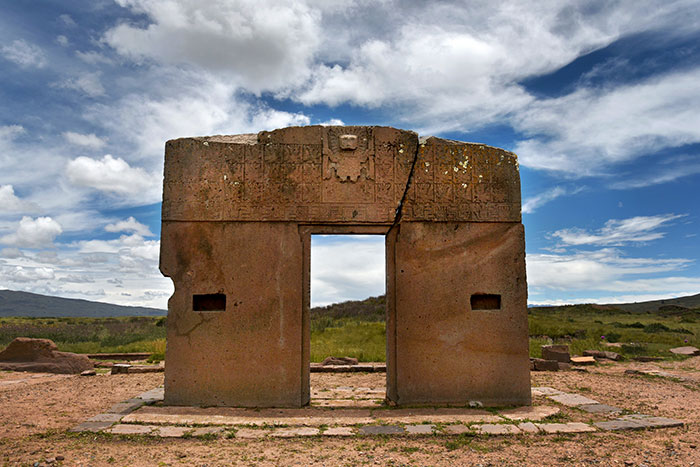
In one desert cemetery at the foot of the Andes, one in every three graves held a kit for inhaling a visionary powder. That powder came from vilca, the seeds of Anadenanthera colubrina, and in the work of Professor Constantino Manuel Torres, PhD, of Florida International University, it becomes a lens for reading two great pre-Inca civilizations. This article explores how the Tiwanaku and Wari used visionary plants in profoundly different ways, and how those choices shaped two profoundly different ways of holding power.
Two Cultures, One Iconography
Between roughly 300 and 1000 AD, the era Andean archaeologists call the Middle Horizon, two civilizations dominated the Central Andes. The Tiwanaku centered on the southern shore of Lake Titicaca; the Wari rose near present-day Ayacucho in Peru. They shared a strikingly similar visual language, built around frontal and profile staff-bearing figures often given the attributes of birds and felines. They also shared a pharmacopoeia of psychoactive plants: Anadenanthera (known as vilca, yopo, or cebil), tobacco, and coca.
Yet beneath those shared icons lay deep divergence. Wari expansion looked colonial: outposts planted far from the capital, emissaries buried with Wari textiles, ceramics, and metalwork, and an architecture that fits the idea of empire. Tiwanaku showed no colonial envoys and no military enforcement of ideology; in places like the oasis of San Pedro de Atacama, Tiwanaku objects simply mingle with local goods. Torres compares this to Christian iconography: a ritual in Rome and one in the American South can share the same central image yet enact entirely different worlds. Shared symbols, in other words, can conceal opposite ideas about power.
Vilca, Snuff, and the Tiwanaku Way
The Tiwanaku sphere favored snuffing and smoking, and the evidence is dense in San Pedro de Atacama, the Chilean oasis that holds the highest concentration of psychoactive-use artifacts anywhere in South America. The typical snuffing kit was carried in a woolen bag: a carved rectangular wooden tray, a tube of wood or bird bone, a bone spoon or spatula, and one or two leather pouches of powder. Making the snuff began with importing Anadenanthera colubrina seeds from the eastern slopes of the Andes, since vilca does not grow on the arid western side. The seeds were dried, roasted, ground to a fine powder, and mixed with tobacco and an alkaline additive.
Chemistry confirms the visionary intent. A snuff sample from Solcor 3, tomb 112 yielded bufotenine (5-hydroxy-DMT) alongside smaller amounts of N,N-DMT and 5-MeO-DMT. A separate ritual bundle from Cueva del Chileno in southwest Bolivia, dated to around 1000 AD, contained bufotenine, DMT, nicotine, and harmine, the last hinting at the harmala-bearing plants that make ayahuasca-style synergy possible. Crucially, this paraphernalia was portable and intimate: snuffing suited the individual, not the crowd.
No human agents or central control necessary, the visionary plants were the agents.
— Constantino Manuel Torres, PhD
Chicha, Feasting, and Wari Power
The Wari took the opposite path: they drank. Their preferred beverage was chicha de molle, a beer brewed from the bright red drupes of the molle tree (Schinus molle), sometimes fortified with Anadenanthera seeds. These were not quiet rituals but large feasts where hundreds of liters were consumed. As Torres notes, the production and consumption of alcohol built an interactive web of reciprocity. The structure of a feast, and who served whom, consolidated social position and forged alliances, often under the dominant pressure of a colonizing host culture.
Scale was the point. The monumental brewery atop Cerro Baúl, in the Moquegua basin, held twelve fermentation vats of roughly 150 liters each and could produce around 1,800 liters per batch, one of the largest breweries known in the Andes. Building and running it meant moving builders, potters, farmers, artists, and brewers, along with their materials, from the Wari heartland near Ayacucho some 400 kilometers away. That logistical reach is visible too in Nasca, where more than forty Wari-affiliated sites introduced colonial outposts, new burial methods, imported ceramics, and the distinctive D-shaped plazas of Wari design. Wari architecture, tellingly, limited public gatherings; there were no great open plazas.
How a Plant Can Shape a Politics
Here Torres makes his central argument: the way a substance is used helps shape the society that uses it. Brewing chicha demanded infrastructure: breweries, storage, serving ware, and the movement of skilled people. That machinery fed naturally into hierarchy and centralized coordination. Snuff was the reverse. A fine powder could be prepared simply, without grand buildings or imported specialists, which made it portable, personal, and hard to monopolize.
The experiences differ as sharply as the logistics. The tryptamine alkaloids in vilca snuff produce a vivid, dynamic visionary state, while low-alcohol chicha tends toward a more sociable, conversational lethargy. Torres links these modes to two political grammars. Wari fits the model of empire, Katharina Schreiber’s “imperial mosaic,” with central control over a vast territory. Tiwanaku looks anarchic in the technical sense: voluntary collaboration, no obedience to a single center, and arrangements that shift with the season. Andean traditions like mink’a, voluntary collective labor, and the kin-based ayllu still carry that logic of reciprocity today.
The Caravans That Carried the Vision
If no emissaries enforced Tiwanaku ideology in the south, how did it travel? The answer seems to be the llama caravan. Vilca seeds had to cross the Andes from their eastern range, and San Pedro de Atacama, hemmed in by poor, mineral-heavy water and a hyper-arid climate that limited farming, depended on these trade circuits for much of what it needed. The oasis sat at a crossroads between the high Andes and the Pacific, exchanging not bulk commodities so much as ideas, rituals, songs, and pharmaceutical know-how.
A subtle clue supports this. Careful stylistic study of the sixty-four Tiwanaku snuff trays at San Pedro shows that each was carved by a different hand, and no two trays share a single artist. That absence of a central workshop suggests the paraphernalia, and the stories engraved on it, circulated widely and were remade along the way. As a tale moved from stop to stop it grew and varied, letting regional communities define their own identity without direction from Tiwanaku itself. One tray from Toconao, dated to about 190 AD, may even predate this imagery at Tiwanaku proper, a hint that the periphery sometimes led the center.
Frequently Asked Questions
What were the visionary plants used by the Tiwanaku and Wari cultures?
Both cultures drew on a shared set of psychoactive plants: Anadenanthera (called vilca, yopo, or cebil), tobacco, and coca. The most important for visionary purposes was Anadenanthera colubrina, whose seeds are rich in the tryptamine bufotenine. The Tiwanaku tended to grind these seeds into a snuff, while the Wari more often added them to chicha, a fermented beer. The plants themselves overlapped; what differed was how each society chose to prepare and consume them.
What is vilca, and where does Anadenanthera colubrina grow?
Vilca is a common Andean name for Anadenanthera colubrina, a tree whose seeds have been processed into visionary snuff for thousands of years. It grows abundantly on the eastern slopes of the Andes, favoring open savannas down to sea level, but does not grow on the arid western slopes where San Pedro de Atacama lies. That geography mattered: communities in the western deserts had to import vilca seeds across the mountains, almost certainly via the llama caravan routes that knitted the region together.
How did the Tiwanaku use visionary snuff?
In the Tiwanaku sphere, snuffing was an intimate, often individual practice rather than a mass event. Users inhaled a finely ground powder of roasted Anadenanthera seeds, frequently blended with tobacco and an alkaline additive. The paraphernalia was portable and personal, which is why it shows up so often in burials. At the Quitor 6 cemetery in San Pedro de Atacama, one in three graves contained a snuffing kit, a striking sign of how woven into daily and ritual life the practice had become.
What was inside a Tiwanaku snuffing kit?
A typical kit was kept in a woolen bag and contained a carved rectangular wooden snuff tray, a snuffing tube made of wood or bird bone, a spoon or spatula usually of bone, and one or two leather pouches holding the powder. Many of the trays were engraved with Tiwanaku iconography: staff-bearing figures, rayed heads, bird- and feline-attributed entities. Of roughly 700 trays found at San Pedro de Atacama, sixty-four carry this imagery, each apparently carved by a different artist.
Why did the Wari drink chicha instead of snuffing?
The Wari favored large, public feasts, and chicha, especially chicha de molle, brewed from the molle tree, suited that social model. Big communal drinking events created reciprocal obligations, displayed wealth, and consolidated power, which fit a hierarchical, expansionist state. Snuffing, by contrast, was personal and small-scale. Torres argues that this is not a coincidence: the mode of consumption and the shape of the society reinforced each other, with collective drinking serving Wari ambitions in a way private snuffing did not.
How do we know these ancient plants were psychoactive?
Beyond iconography and the abundance of paraphernalia, there is direct chemistry. Analysis of a snuff sample from Solcor 3, tomb 112 in San Pedro de Atacama detected bufotenine (5-hydroxy-DMT) with smaller amounts of N,N-DMT and 5-MeO-DMT. A roughly 1,000-year-old ritual bundle from Cueva del Chileno in Bolivia tested positive for bufotenine, DMT, nicotine, and harmine. These results confirm that the powders were genuinely visionary preparations, and that some included the harmala alkaloids associated with ayahuasca-style combinations.
What is bufotenine, and how is it related to DMT?
Bufotenine is 5-hydroxy-DMT, a tryptamine closely related to the more familiar N,N-DMT. It is the dominant active compound in Anadenanthera colubrina seeds, which is why its presence in ancient snuff samples points to vilca as the source. The chemical analyses from the region typically show bufotenine in the largest amounts, with N,N-DMT and 5-MeO-DMT present in smaller quantities, a tryptamine profile that produces the vivid, fast-acting visionary state characteristic of inhaled Anadenanthera preparations.
Where can I learn more about Andean ethnobotany and visionary plants?
The McKenna Academy’s Living Library is built for exactly this kind of inquiry: ethnobotany taught with the culture left in. Its courses span the relationship between people and plants, Andean traditions such as the coca leaf, the chemistry of visionary tryptamines, and the broader practice of plant medicine and shamanic healing. Taught by recognized scholars including Michael A. Coe, Steven King, Wade Davis, and Dennis McKenna, the library offers a grounded way to go deeper than any single article can.

Constantino Manuel Torres, PhD
Professor Emeritus of Art History, Florida International University
Constantino Manuel Torres has researched the ancient cultures of the South-Central Andes since 1982, with a long focus on the San Pedro de Atacama oasis and the use of Anadenanthera-based snuffs. He co-authored Anadenanthera: Visionary Plant of Ancient South America (2006) with David Repke, a detailed study of a plant in continuous use for some four thousand years, and has published widely on the art and archaeology of the Andes.
★ Recipient of three Fulbright Fellowships
Manuel Torres: Tiwanaku and Wari: Psychoactive plants and politics in the Central Andes – ESPD55
Dr. Constantino Manuel Torres, PhD · 1 hr · McKenna Academy
McKenna Academy · Living Library
Go Deeper with Ethnobotany
The story of Haoma shows why context matters: a plant’s meaning lives in the rituals, languages and communities that carry it, not in its chemistry alone. The Living Library brings together leading researchers to teach the science and the lineage of visionary plants side by side.
Ethnopharmacologic Search for Psychoactive Drugs
This article draws on Professor Constantino Manuel Torres, PhD chapter from the ESPD Vol III — part of the series edited by Dennis McKenna and published with Synergetic Press. The collector’s box set reprints the original 1967 proceedings alongside the 50-year anniversary research.
Hardback editions · Learn about ESPD50 & ESPD55 →