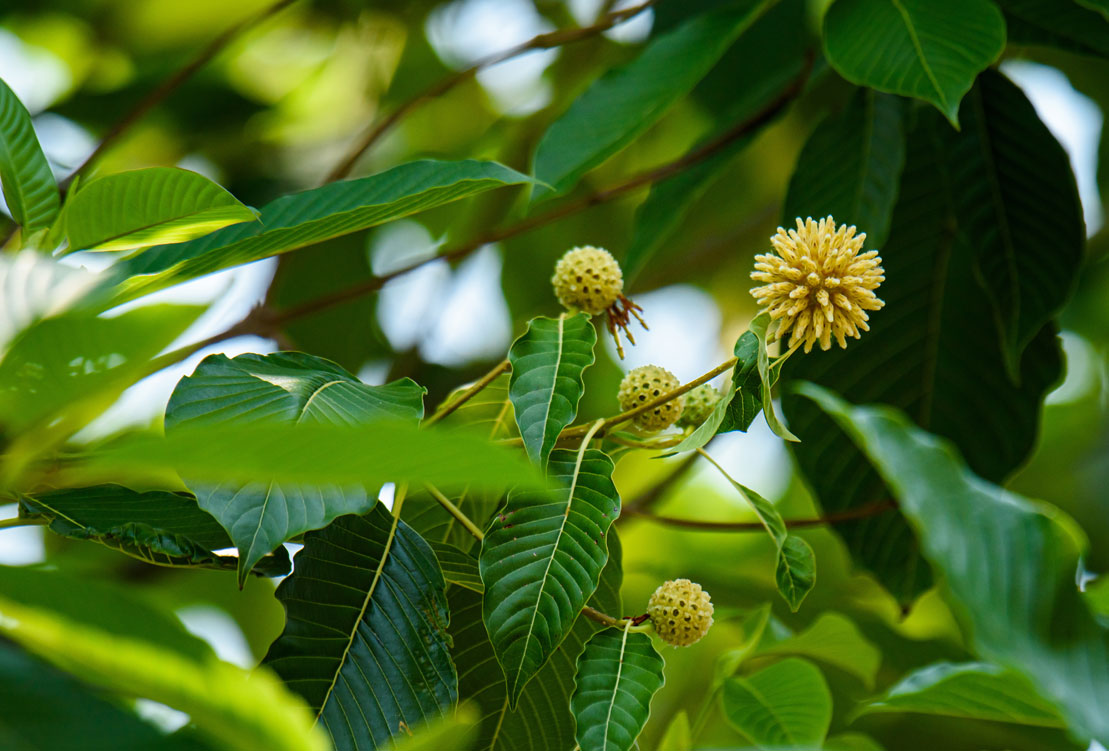
In Southeast Asia, the leaf of a tall swamp tree has been chewed and brewed into a working person’s tea for generations, yet across centuries of daily use, not a single death has been linked to it alone. That tree is Mitragyna speciosa, or kratom, and the scientist who has spent a quarter of a century decoding it is Professor Christopher R. McCurdy, PhD, of the University of Florida College of Pharmacy. This article follows his research into what kratom actually is, why he insists it is not an opioid, and what its remarkable chemistry may offer a world in the grip of an opioid crisis.
What Is Kratom?
Kratom is the common name for Mitragyna speciosa, a tropical tree in the Rubiaceae family, the same botanical family as the coffee plant, though kratom contains no caffeine. Its genus name comes from the shape of the leaf: turned on its side and stood upright, it resembles a bishop’s mitre. Native to the swampy lowlands at the interface of peninsular Malaysia and Thailand, the tree thrives in standing water, and human cultivation has since carried it across Southeast Asia. Most material reaching Western markets today is reported to come out of Indonesia.
The name itself shifts with geography. In Thailand it is kratom (krat-tom); in Malaysia it is ketum (key-tum). The Westernised “craytum” pronunciation, McCurdy notes, was effectively invented in the United States and is not recognised in the plant’s homeland, a small but telling sign of how far the plant has travelled from the communities who know it best.
A Living Tradition in Southeast Asia
In Malaysia and Thailand, kratom is woven into everyday working life. Trees grow in household yards, and in Malaysia it is legal to keep a tree and prepare kratom for personal use, even though selling it is not. The traditional preparation is simple: fresh leaves are plucked, torn or cut to expose more surface area, and boiled for two to three hours to make a tea the users call “juice.” It is consumed roughly three times a day, morning, afternoon and early evening, often split with warm water, much as others might reach for coffee.
Crucially, kratom is titrated to effect rather than taken as a fixed dose; as a natural product, potency varies from batch to batch. Outdoor labourers have long used it to sustain work through the heat of the day and to ease aches as they work. McCurdy is careful to frame this not as folklore but as living knowledge: the people who use kratom traditionally observe things science is only beginning to catch up with, for instance, that the brewed tea loses its activity after about 48 hours, even though laboratory analysis shows the alkaloids remain chemically intact.
This polypharmacology renders kratom unique from other opioids, and to label kratom an opioid is scientifically and factually incorrect.
— Christopher R. McCurdy, PhD
Why Kratom Is Not Simply an Opioid
The US Food and Drug Administration classifies kratom as an unregulated opioid. McCurdy argues this is fundamentally wrong. While kratom does interact with opioid receptors, it also engages a wide array of other targets , serotonergic, adrenergic and dopaminergic among them. He describes the plant as a “symphony orchestra” of activity and has coined a term for its paradoxical profile: disruptive pharmacology. Unlike pure opioids, which are depressants, kratom also carries stimulant and mood-elevating effects, a combination that does not fit neatly into any existing drug category.
This is more than a semantic quarrel. Across Southeast Asia, labourers who use traditional opium report turning to kratom when opium runs short, to stave off withdrawal. That observation is what drew McCurdy’s team toward the question now at the centre of their work: could a plant that nature placed alongside the opium poppy help unwind the crisis the poppy has fed? Surveys conducted with collaborators at Universiti Sains Malaysia even found that poly-drug users were able to reduce their methamphetamine consumption with kratom, striking, given that no approved treatments for stimulant use disorder exist.
The Alkaloid Symphony
More than 40 alkaloids have been reported from kratom, and McCurdy’s lab has isolated and profiled many of them, “listening” to each instrument on full blast, while never forgetting that the music is the whole orchestra. The most famous is mitragynine, a corynanthe-based indole alkaloid long treated as the plant’s defining compound. Yet his team’s sampling tells a more complicated story. Older literature claimed mitragynine made up 66% of total alkaloid content; fresh-leaf analysis across many trees found it ranging from just 0.7% to 38.7%. Far from being a fixed quantity, the plant appears to have at least two or three distinct chemotypes, echoing the way cannabis varies in its cannabinoids.
Mitragynine is a partial mu-opioid receptor agonist, reaching only about 40% maximal activation, behaviour similar to buprenorphine, a medicine used to bring people off stronger opioids. It also acts as a biased agonist, favouring G-protein signalling over beta-arrestin, which is associated with fewer of the side effects (respiratory depression, constipation) that make classic opioids dangerous. The team further found genuine alpha-adrenergic activity, meaning a single kratom alkaloid could, in principle, do the work of two separate withdrawal medications at once.
Then there is 7-hydroxymitragynine (7HMG), once thought to be present in the living plant. McCurdy’s work suggests it is largely a post-harvest artifact and a minor metabolite, but a potent one, with high abuse potential in self-administration studies. By contrast, mitragynine itself did not substitute for morphine in those same studies. Other alkaloids are now emerging from the shadows: speciociliatine, an isomer of mitragynine, turns out to be the second-most-exposed alkaloid in the bloodstream and may be a key overlooked player, while paynantheine and speciogynine show high affinity for serotonin receptors that can actually counteract opioid-induced respiratory depression.
Safety, Regulation and the Therapeutic Question
Kratom sits at the centre of a genuine paradox. It is claimed to be severely addictive and deadly, yet in Southeast Asia there has not been a single reported death attributed to kratom over centuries of traditional use. Many of the alarming Western reports involve adulterated or contaminated products; McCurdy’s lab has fingerprinted pure kratom and repeatedly found commercial samples spiked with substances such as fentanyl. One widely cited headline linking kratom to roughly 100 overdose deaths, he points out, conceded deep in the article that nearly all the samples had been laced with fentanyl.
Studies of typical users (three to five grams, a few times daily) report only mild withdrawal, comparable to caffeine, though very heavy users can struggle to stop. The major scientific gap is the absence of standardised product for rigorous clinical trials, a problem McCurdy’s group is helping to close by growing its own kratom farm in Florida, where the tree may even offer a lifeline to citrus farmers facing the incurable blight of citrus greening. In 2021 a WHO Expert Committee, which McCurdy addressed, declined to recommend an international ban, citing both the plant’s role as an indigenous medicine and its emerging therapeutic promise. His message is one of caution against haste: rather than discard kratom, we should keep listening to what the plant is trying to teach us.
2026 Update: Mitragynine Enters Human Trials
June 2026. The gap described above has begun to close. The National Institutes of Health announced that its Investigational New Drug (IND) application for mitragynine had taken effect with the FDA, clearing the way for an NIH-led phase I clinical trial of the purified compound as a potential treatment for opioid use disorder. The formulation was developed by the NIH together with the University of Florida, McCurdy’s own institution, alongside the preclinical work that supported the application.
It is worth being precise about what this is and is not. The study is a randomised, double-blind, placebo-controlled trial of safety and tolerability in healthy volunteers, not yet a test of whether mitragynine treats opioid use disorder, and no results have been published. What makes it a milestone is that it is the first time isolated mitragynine has been studied in humans under an FDA-regulated drug development program. It is exactly the kind of standardised, rigorous trial McCurdy argues the field has lacked, and a sign that the questions raised in this article are now moving from the laboratory toward the clinic.
Frequently Asked Questions
What is kratom (Mitragyna speciosa)?
Kratom is the common name for Mitragyna speciosa, a tropical tree in the coffee family (Rubiaceae) native to Southeast Asia. Its leaves contain a complex mixture of more than 40 alkaloids and have been used traditionally for generations, brewed into a tea or chewed, to sustain physical labour, ease pain and lift mood. Professor Christopher McCurdy describes it not as a single drug but as a “symphony orchestra” of compounds, whose combined activity gives it a profile unlike any conventional medicine.
Where does the name kratom come from?
The genus name Mitragyna derives from the shape of the leaf, which, stood upright, resembles a bishop’s mitre or hat. The plant’s common names shift by region: kratom (krat-tom) in Thailand and ketum (key-tum) in Malaysia. The Westernized pronunciation “craytum” was effectively created in the United States and is not recognized in Southeast Asia, where the plant has been part of daily life far longer than it has been known in the West.
How is kratom used traditionally in Southeast Asia?
In Malaysia and Thailand, fresh leaves are plucked, torn or cut to expose more surface area, then boiled for two to three hours to make a tea users call “juice.” It is consumed roughly three times a day, morning, afternoon and early evening, often diluted with warm water, much like coffee. Outdoor labourers have long relied on it to work through heat and ease aches. Importantly, kratom is titrated to effect rather than taken at a fixed dose, and potency varies naturally from batch to batch.
Is kratom an opioid?
Not in the usual sense, according to McCurdy. Although kratom interacts with opioid receptors, it also engages serotonergic, adrenergic and dopaminergic targets, activity he calls “disruptive pharmacology.” Conventional opioids interact only with opioid receptors and act as depressants, whereas kratom also has stimulant and mood-elevating effects. The plant’s main alkaloid, mitragynine, is only a partial mu-opioid agonist, reaching about 40% maximal activation. For these reasons he argues that labelling kratom an opioid is scientifically and factually incorrect.
Is kratom dangerous or addictive?
The evidence presents a paradox. Across centuries of traditional use in Southeast Asia, no death has been attributed to kratom alone, and studies of typical users report only mild withdrawal. Most alarming Western reports involve adulterated products, McCurdy’s lab has found commercial samples laced with fentanyl, or extremely high doses far above traditional levels. Very heavy users can find it hard to stop. As with any substance, the dose matters: documented overdose cases involved mitragynine blood levels many times higher than those of regular traditional users.
Can kratom help with opioid withdrawal?
This is the central question driving McCurdy’s research. Many people report using kratom to move off prescription opioids without going into withdrawal, and traditional users in Asia turn to it when opium runs short. Pharmacologically, kratom alkaloids combine partial mu-opioid activity with alpha-adrenergic activity, mirroring how withdrawal is currently treated with two separate medications. While the early signals are promising, McCurdy stresses that firm claims must wait for rigorous clinical trials with standardised product. As of 2026 the first such trial, an NIH phase I study of purified mitragynine, has been cleared and is getting underway, but its results are not yet in.
What is the difference between mitragynine and 7-hydroxymitragynine?
Mitragynine is kratom’s most abundant alkaloid and a partial mu-opioid agonist; in self-administration studies it did not substitute for morphine, suggesting low abuse potential on its own. 7-hydroxymitragynine (7HMG) is a far more potent opioid that does show high abuse potential, but McCurdy’s work indicates it is largely a post-harvest artifact and a minor metabolite, present at very low levels in fresh, properly handled leaf. Distinguishing the two is essential to understanding why whole-leaf kratom behaves so differently from isolated compounds.
Where can I learn about ethnobotany and plant medicine properly?
Kratom is a reminder that a plant’s wisdom lies in its whole context, its chemistry, its ecology, and the communities who have stewarded it. The McKenna Academy Living Library explores exactly this: rigorous, respectful courses on ethnobotany, plant chemistry, traditional medicine and the science of psychoactive plants, taught by recognized researchers. It is a place to study these subjects with both scientific depth and reverence for Indigenous knowledge, rather than stripping the culture from the plant.

Professor Christopher R. McCurdy, PhD
Professor of Medicinal Chemistry, University of Florida · Director, UF Translational Drug Development Core
Dr. McCurdy holds the Frank A. Duckworth Eminent Scholar Chair in Drug Research and Development at the University of Florida College of Pharmacy. A broadly trained pharmaceutical scientist and pharmacist, he has spent over 25 years designing and developing drugs to treat pain, anxiety and substance use disorders, and is internationally recognised as a leading expert on kratom (Mitragyna speciosa). He has published more than 150 manuscripts, holds six patents, and serves as a consultant to the US FDA’s Drug Safety and Risk Management Advisory Committee.
★ Past President, American Association of Pharmaceutical Scientist
Kratom, Recent advances in understanding the chemistry, pharmacology, and human uses – ESPD55
Dr. Christopher R. McCurdy · 1 hr 19min · McKenna Academy
McKenna Academy · Living Library
Go Deeper with Ethnobotany
Kratom shows why context is everything: the same plant can be medicine or menace depending on how, and by whom, its knowledge is held. The Living Library brings together leading researchers to teach ethnobotany, plant chemistry and traditional medicine with rigor.
Ethnopharmacologic Search for Psychoactive Drugs
This article draws on Professor McCurdy’s chapter in the ESPD Vol III, edited by Dennis McKenna and published with Synergetic Press. The collector’s box set reprints the original 1967 proceedings alongside the 50-year anniversary research.
Hardback editions · Learn about ESPD50 & ESPD55 →