

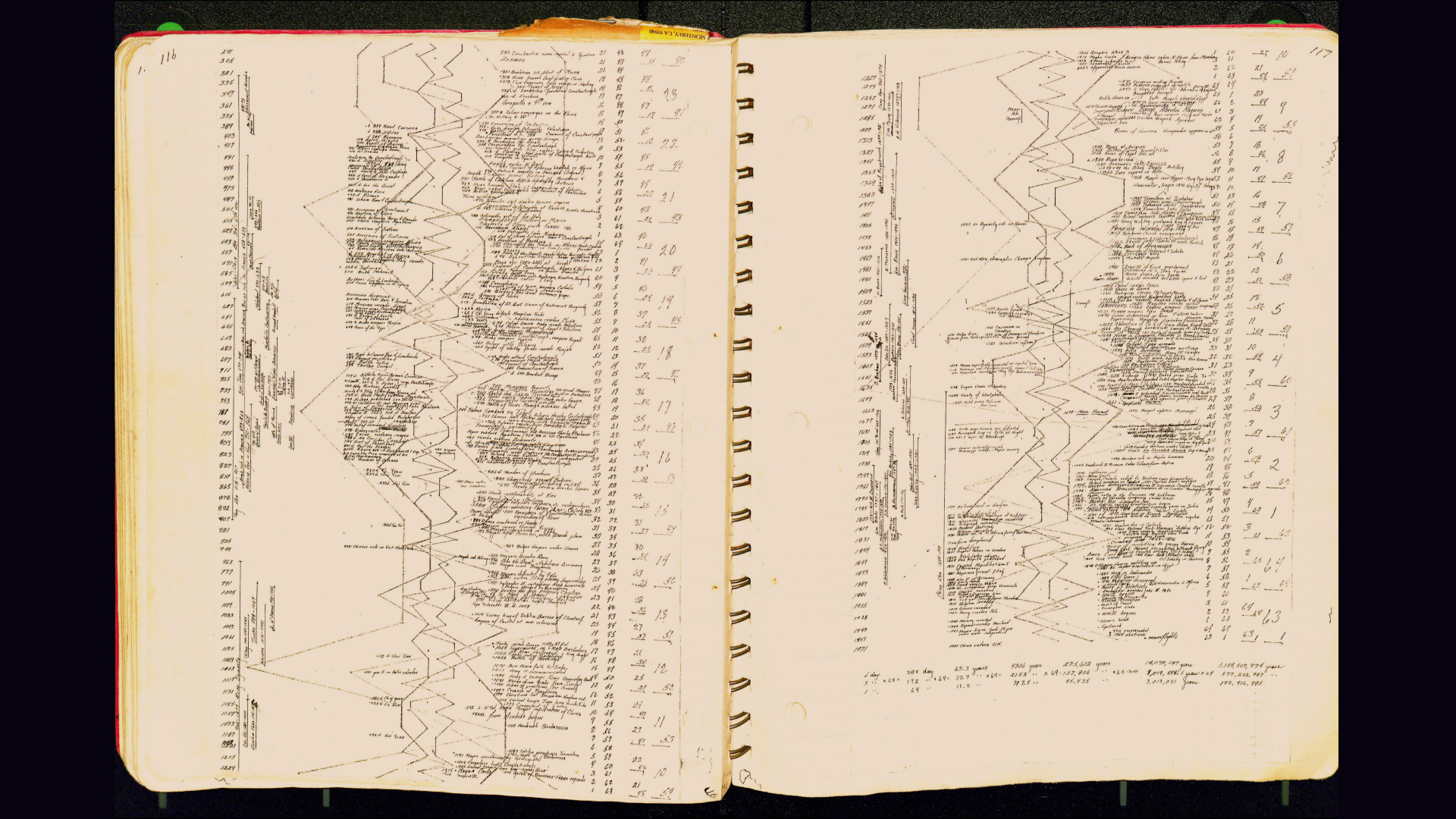
Timewave Zero is the graph at the heart of Terence McKenna’s Novelty Theory: a wave built from the ancient Chinese I Ching that, he proposed, traces the rise and fall of novelty through history and reaches zero, a point of infinite novelty, on 21 December 2012.
McKenna developed the idea with his brother Dennis after their 1971 expedition to La Chorrera in the Colombian Amazon, set it out in The Invisible Landscape (1975), and turned it into software in 1987. It became one of the best-known and most criticised parts of his work. This page explains what the Timewave claims, how it was built, why the 2012 date was chosen, and what remains of the idea now that the date has come and gone.
A note on standing
Novelty Theory is visionary philosophy, not accepted science. Its predicted endpoint passed without event, and a central step in its mathematics was shown to have no documented justification. We present it here as an important part of the McKenna brothers’ intellectual history, with the criticism kept on the record.
What is Novelty Theory?
McKenna proposed that the universe is shaped by two opposing tendencies: habit, the pull toward repetition and conservation, and novelty, the drive toward new forms, greater complexity and denser connection. In his telling, novelty has been winning since the beginning. Hot plasma gave way to atoms and stars, then to carbon chemistry, cellular life, sexual reproduction, language and culture, and each new level arrived faster than the one before.
From that pattern he drew his most dramatic inference. If novelty is accelerating, history is not being pushed from behind by the past so much as pulled toward a future attractor, which he called the Eschaton or the “transcendental object at the end of time.” McKenna drew on Alfred North Whitehead’s philosophy of process and on Pierre Teilhard de Chardin’s idea of an Omega Point, but he went further than either by claiming the acceleration could be measured, graphed and dated.
Where the Timewave came from
The theory grew directly out of La Chorrera. In the weeks after the brothers’ experiment there in March 1971, Terence became convinced that the I Ching, the Chinese Book of Changes, encoded a map of time itself. He and Dennis worked through the idea in The Invisible Landscape. In 1987 Terence completed the first Timewave Zero software with programmer Peter Meyer, which let anyone plot the wave against any span of history.
How the Timewave was built
The construction is unusual but can be followed step by step. In outline:
1
Start with the King Wen sequence
The traditional ordering of the I Ching‘s 64 hexagrams, each made of six broken or unbroken lines.
2
Count the changes
For each hexagram, count how many of its six lines change on the way to the next one in the sequence. McKenna called this the first order of difference, and it yields 64 numbers.
3
Expand to 384 values
Following the six lines of each hexagram, the pattern is expanded to 384 values (64 × 6). McKenna linked 384 days to thirteen lunar months.
4
Treat it as a fractal
The same pattern is assumed to repeat at nested scales, each 64 times shorter than the one above, and the scales are combined into a single curve.
5
Fix it to the calendar
The curve is laid over real history so that its lowest point, maximum novelty, falls on a chosen end date. Lower values on the graph mean more novelty.
The full derivation
How the Timewave Was Made walks through every step, from the King Wen sequence to McKenna’s 384 values, using the actual published data. It also stops at the one step nobody could justify.
Why 21 December 2012?
The end date was not read off the I Ching. McKenna chose it by fitting the wave to history. He looked for a recent event of extreme novelty to anchor the curve and picked the atomic bombing of Hiroshima on 6 August 1945. Counting forward from there placed the end of the wave in mid-November 2012. When McKenna later learned that the Maya Long Count calendar completed a great cycle on 21 December 2012, he adjusted the zero point to match.
That sequence matters for judging the theory. A prediction derived independently and then confirmed by the Maya date would have been striking. A date chosen to fit, then moved to coincide with a second calendar, is a retrofit. The Timewave’s link to 2012, which made it famous, is also the clearest sign of how much of it was interpretation.
“The universe is an engine for the conservation of complexity, or novelty.”
— Terence McKenna, on the core intuition of Novelty Theory
The mathematical critique
In 1996 the British mathematician Matthew Watkins examined the Timewave’s construction in detail, with McKenna’s cooperation. His essay, “Autopsy for a Mathematical Hallucination?”, identified a step in the software’s calculation, which he called the “half twist,” that reverses the sign of half of the 64 starting values. The step does not appear in The Invisible Landscape, and without it the calculation produces a noticeably different wave.
When asked, McKenna could not recall why the step had been included, more than twenty years after the original work. He offered arguments for it based on the symmetry of the data, which Watkins found unconvincing, and by Watkins’s account McKenna accepted that those arguments did not justify the step. Others, notably John Sheliak, later produced revised versions intended to repair the mathematics, but none has changed the scientific verdict.
Then the date itself arrived. 21 December 2012 passed like any other day.
What survives of the Timewave
As prediction, the Timewave failed. McKenna took that risk knowingly: he preferred a claim specific enough to be proved wrong to one too vague to be tested, and in his last years he sometimes spoke of the date with open irony. As an image, though, Novelty Theory has lasted. The sense that history is accelerating, that complexity builds on itself ever faster, and that distant eras can rhyme with one another is shared well beyond McKenna’s readers. It surfaces today in conversations about technology, networks and artificial intelligence.
The fairest reading may be the one the McKenna Academy brings to all of Terence’s work: take the questions seriously, test the claims honestly, and keep what survives. The Timewave did not survive testing. The question behind it, whether the universe has a direction and whether we are part of it, is still open. The same approach runs through Dennis McKenna’s re-examination of his brother’s other great hypothesis, the Stoned Ape theory, and through the courses of the Living Library.
Frequently asked questions
What is Timewave Zero?
Timewave Zero is Terence McKenna’s graph of novelty over time, built from the King Wen sequence of the I Ching. It was also the name of the 1987 software he created with Peter Meyer to plot it. The wave descends toward a “zero point” of maximum novelty, which McKenna placed on 21 December 2012.
What did Terence McKenna think would happen in 2012?
He described the zero point as a moment of infinite novelty, a transformation so great it could not be imagined from this side of it. He did not commit to a single scenario. The date passed without any event of the kind.
Is Novelty Theory scientific?
No. It is a speculative, visionary philosophy. Its end date was fitted to history rather than derived, its central mathematics contains an unexplained step, and its prediction failed. Its lasting value is as a way of thinking about accelerating complexity, not as a testable model.
What is the “half twist” in the Timewave?
A step in the Timewave calculation that reverses the sign of half of the 64 starting values. Mathematician Matthew Watkins showed in 1996 that it was not described in The Invisible Landscape and that removing it changes the wave substantially. McKenna could not give a clear reason for it.
Did Dennis McKenna work on the Timewave?
Dennis co-wrote The Invisible Landscape (1975), where the ideas behind the Timewave were first set out, and shared the 1971 La Chorrera experience they grew from. The software and its later development were Terence’s work with Peter Meyer. Dennis went on to a career in empirical plant science and founded the McKenna Academy in 2019.
Part of the Terence McKenna archive
Terence McKenna: biography, timeline, books and archive
His life, his key ideas and everything the Academy has published about him.


