

From the King Wen sequence to the wave — the derivation, step by step
Abstract
The Timewave was not drawn freehand. It was constructed, in eight moves, from a single ancient object: the order in which the 64 hexagrams of the I Ching are traditionally arranged. This page walks the construction exactly as McKenna published it — and pauses, honestly, at the one step nobody could ever justify.
Provenance
Every figure below is generated live from the published record: the hexagram transitions match the table in Watkins’s critique, and the 384 wave values are McKenna’s own Table 2. Nothing is redrawn from memory — you are looking at the actual numbers.
I
The raw material
The King Wen sequence
The I Ching contains 64 hexagrams — every possible stack of six lines, each line either solid (yang) or broken (yin). The oldest known ordering of these 64 figures is the King Wen sequence, and it has a strange internal discipline: the hexagrams come in pairs, where the second of each pair is the first turned upside down. Eight hexagrams look the same upside down; those are instead paired with their opposite — every line flipped.
McKenna’s starting intuition was that this sequence is not decorative. If the ancient arrangers encoded something deliberate in the ordering, then the transitions between hexagrams — how much changes from one to the next — might carry information. That question is the seed of everything that follows.
II
The first order of difference
64 transitions
Walk the sequence and count, at each step, how many of the six lines change to turn each hexagram into the next (the sequence wraps: hexagram 64 steps back to hexagram 1). The result is a series of 64 small integers — the first order of difference. Graphed, it looks random. It is not.
The properties McKenna found here convinced him the sequence was engineered:
In his words, these regularities are not coincidences but the artifacts of conscious intent — the fingerprints, he believed, of the sequence’s ancient designers.
III
Closure — the double wave
Forward & backward
Now the first strange move. Take the graph of Figure 1, rotate a copy of it 180° in the plane, and lay it back over the original. McKenna found that the two curves touch at both ends — they close, like a sealed vessel — and that hexagrams facing each other across the closed figure always have position numbers summing to 64.
This closed, bi-directional figure — 384 lines of change — is the object everything else is built from. McKenna treated it the way the I Ching treats a single line: as a unit that can itself be stacked and scaled.
IV
The tri-level wave
6 · 2 · 1
A hexagram is six lines — but it is also two trigrams, and it is also one whole figure. McKenna rebuilt that anatomy out of his double wave: six copies end-to-end at the line scale, two copies (each three times larger) at the trigram scale, and one copy (six times larger) spanning the whole. All share one origin and one end point.
He also noticed the arithmetic of the object rhymed with the sky: 384 subunits is almost exactly 13 lunar months (29.53 × 13 = 383.89 days) — suggesting, to him, that the figure had once been a lunar calendar.
V
Quantification — the 384 values
Table 2
To turn geometry into numbers, every feature of the tri-level wave was scored: the skew of each line segment (thirteen discrete types, signed by direction), the divergence between the forward and backward curves (seven types of gap and overlap), and the scale of the level it sits on (trigram values ×3, hexagram values ×6). Collapsing all of it into a single line of numbers yields the data set at the heart of the theory: 384 integer values.
Interjection · the contested step
The half-twist
Between the geometry and the published numbers there is one more operation — and it appears nowhere in The Invisible Landscape. It surfaces only in a footnote of the TimeExplorer software manual, where, midway through the algorithm, the sign of half the values is silently flipped:
for 1 ≤ j ≤ 32:
    angle_lin[j] = −angle_lin[j]      // footnote 22: the "half twist"
The manual’s own footnote concedes the reason for this step is “not well understood at present and is a question which awaits further research.”
In 1996 the mathematician Matthew Watkins condensed the whole construction into a single formula and put his finger exactly here: remove the half-twist and the 384 values change — and with them the entire wave, and every historical “fit” claimed for it. Confronted at Palenque, McKenna could not reconstruct a justification. John Sheliak later published a re-derivation defending a corrected wave; Watkins maintained the objection stands. The full exchange is kept in this node’s archive.
§4.4 — “Autopsy for a Mathematical Hallucination” · the critique, response, and defence →
VI
Fractal expansion
The 384 values describe one cycle — but the construction doesn’t stop at one scale. Each of the 64 segments of the wave contains a complete copy of the whole wave, 64 times compressed, its values combined with its parent’s. And the whole wave is itself one segment of a wave 64 times larger. The result is an infinitely nested, self-similar object: a fractal, years before the word was common currency.
Because every scale contains every other, distant eras can occupy the same position on their respective cycles. McKenna called this temporal resonance — his explanation for why history seems to rhyme. The durations ladder up by the sequence’s own numbers:
| Duration | Multiplier | Yields | Astronomical echo |
|---|---|---|---|
| 64 days | × 6 lines per hexagram | 384 days | 13 lunations |
| 384 days | × 64 hexagrams | 67.3 solar years | 6 minor sunspot cycles |
| 67.3 years | × 64 | 4,306+ years | 2 zodiacal ages |
| 4,306 years | × 6 | 25,836 years | 1 precession of the equinoxes |
VII
From wave to history
Choosing the zero date
One thing remains to make the object a map: pinning it to the calendar. The wave’s mathematics fix its shape but not its position — some date must be chosen as the zero point where the final cycle ends, and every other date follows from it. McKenna screened the wave against history and chose the fit he found most convincing: a 67.3-year cycle beginning at Hiroshima lands in mid-November 2012, which he then nudged to 21 December 2012 to meet the end of the Maya Long Count.
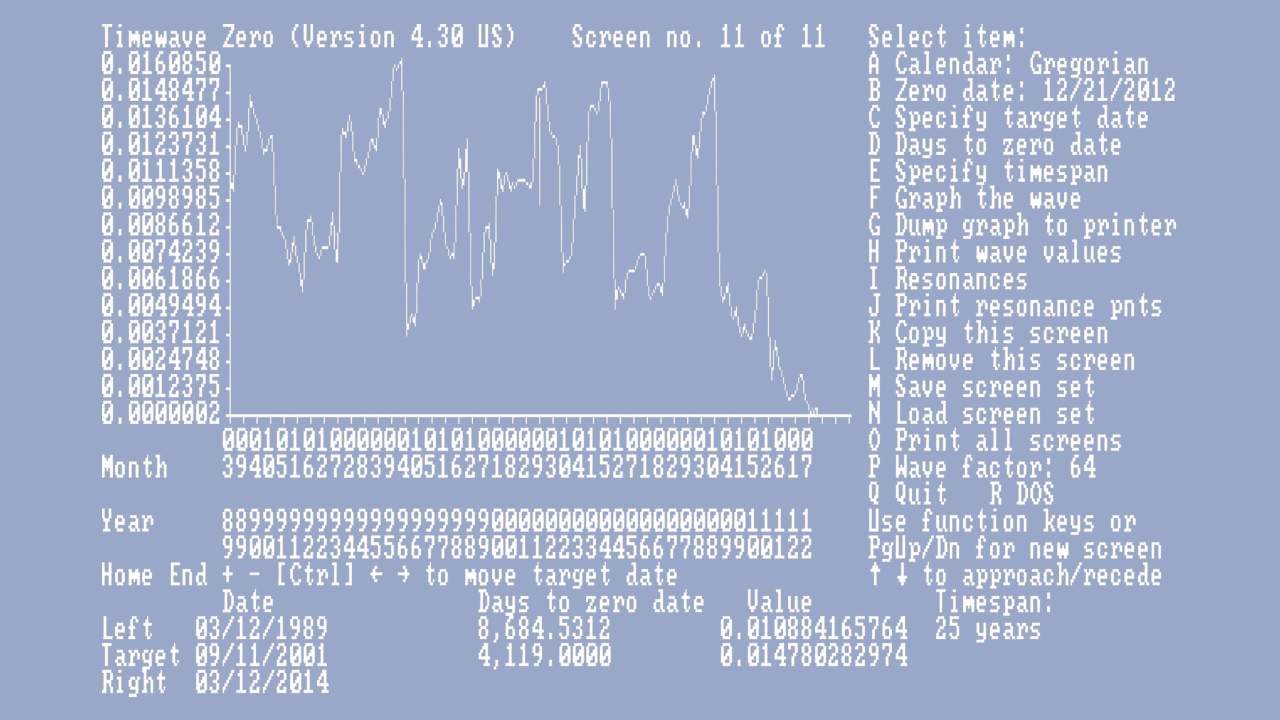
That is the honest shape of the final step: the endpoint was selected, not derived — a best fit, chosen by eye, on a wave whose own numbers rest on the half-twist. The finished object is the one you can drag through on the node page: novelty rising as the wave falls, all the way down to a chosen zero.

Part of the Terence McKenna archive
Novelty Theory & Timewave Zero
Sources. Terence McKenna, Derivation of the Timewave from the King Wen Sequence of Hexagrams; Peter Meyer, TimeExplorer software manual (footnote 22); Matthew Watkins, Autopsy for a Mathematical Hallucination? (with McKenna’s introduction and response); John Sheliak, A Mathematical and Philosophical Re-Examination of the Foundations of TimeWave Zero. Figure data on this page is computed from the published hexagram transitions and McKenna’s Table 2, verified against Watkins’s h[k] table. Presented as part of McKenna Academy’s record — the construction shown faithfully, the objection kept beside it.


