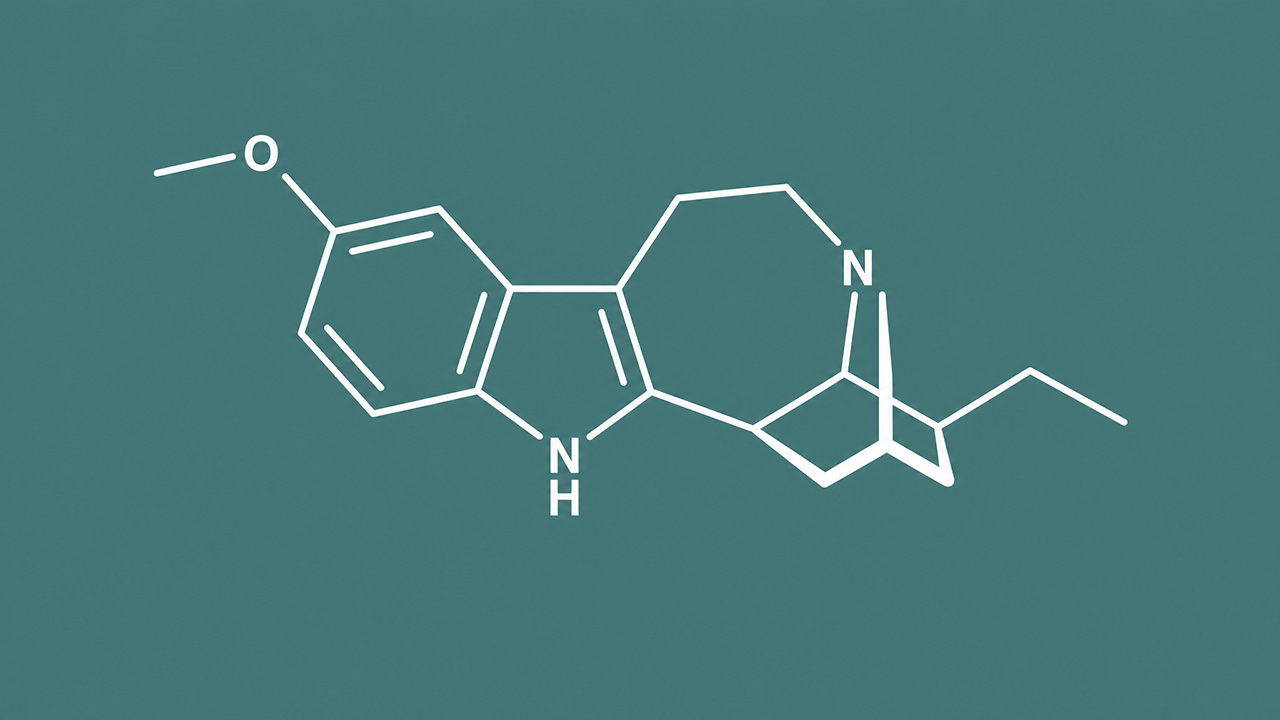
Ibogaine is a monoterpene indole alkaloid that occurs in the root bark of Tabernanthe iboga, a shrub of West Central Africa whose scrapings have been eaten as a sacrament of the Bwiti religion for several centuries. Outside Africa the same alkaloid took a different path, carried not by clinicians but by opioid-dependent people who used it to interrupt their own withdrawal. Kenneth Alper describes what that has produced: a body of observation, a serious safety problem, and a mechanism of action resembling nothing else in addiction medicine.
From Bwiti Sacrament to Urban Ethnomedicine
In Gabon and elsewhere in West Central Africa, ibogaine is ingested as eboga, scrapings of Tabernanthe iboga root bark, and has served as a sacrament of the Bwiti religion for several centuries. The ritual aim has been conceptualised as a binding across time, through the work of the ancestors, and across space, through a shared experience of a distinctive state of consciousness. In the colonial era, Bwiti offered a dignified realm of spiritual endeavour that supported resistance to the dislocation of colonial rule, and became constellated with Gabonese national identity.
Outside Africa, ibogaine has been used for something else entirely: detoxification from opioids. The medical and nonmedical settings where this happens have been collectively described as a vast uncontrolled experiment, or a medical subculture. Ibogaine has been classified as a hallucinogen and illegal in the United States since 1967, and is similarly scheduled in nine of the twenty-eight countries of the European Union. Elsewhere it is often neither approved nor illegal, while New Zealand, Canada, Brazil and South Africa treat it as a pharmaceutical restricted to licensed practitioners. A survey of known settings as of 2006 counted roughly 3,400 individuals who had taken ibogaine, 68 percent of them for a substance-related disorder and 53 percent specifically for opioid detoxification. A decade later, Alper notes, the total has likely increased several-fold.
Ethnopharmacological drug discovery normally begins with observational evidence of a clinical effect in an indigenous context of use. Ibogaine follows that paradigm, Alper argues, with an unfamiliar indigenous context: the participants are dependent on opioids, and the ritual space is a clinic outside the United States, or an apartment or a hotel room.
What the Clinical Evidence Shows
Two early case series established that something substantive was happening. In 33 opioid detoxification episodes performed in nonmedical settings, full resolution of withdrawal signs and symptoms without drug-seeking behaviour was observed over 72 hours in 25 patients. A separate study of 32 patients in a medical setting reported resolution at 24 hours on physician-rated instruments.
The strongest recent data come from a prospective study following 30 individuals for a year after ibogaine detoxification. All were heavy opioid users with histories of failure on conventional treatment. Baseline scores on the Subjective Opioid Withdrawal Scale fell by a mean of 17 points, from 31.0 to 14.0, within roughly three days. At one and three months, 15 subjects (50 percent) and 10 subjects (33 percent) reported no opioid use in the previous 30 days. For comparison, systematic reviews of detoxification without subsequent maintenance treatment report abstinence rates of 18 percent at four weeks after buprenorphine and 26 percent at six weeks after methadone.
Alper is direct about the limits: these studies have been uncontrolled and reliant on self-report without laboratory verification. He argues the detoxification findings still hold, because acute withdrawal evolves over a limited time frame, is robust in its expression, and can be assessed accurately even by lay providers. The preclinical work is consistent: more than 50 published studies have examined ibogaine or its analogs in animal models, with single doses diminishing self-administration of morphine, heroin, cocaine, amphetamine and alcohol while normal responding for water was preserved.
True intention, equanimity, distinct from the constraints of obsession and the pathological overattribution of salience, is both a cardinal spiritual goal and a desired outcome of pharmacological treatment of addiction.
— Kenneth Alper, MD
The Waking Dream: Panoramic Memory and Equanimity
Ibogaine entered the medical model in the 1950s, when Jan Bastiaans, Leo Zeff and Claudio Naranjo were interested in it as an adjunct to psychotherapy, and when it may also have been investigated as a truth serum or incapacitating agent under the CIA project MKULTRA. The French chemist Robert Goutarel hypothesised that ibogaine produces a state sharing functional aspects with REM sleep. Subjective descriptions have been designated as oneiric and likened to a waking dream, with interrogatory verbal exchanges involving ancestral and archetypal beings, and movement within visual landscapes. Another frequently described experience is panoramic memory, a rapid, dense succession of vivid autobiographical images that has been termed the slide show. These may point to functional muscarinic cholinergic effects, prominent in dreaming and memory, though the pathway is unresolved: more recent work shows ibogaine does not inhibit acetylcholinesterase.
The recurring theme in first-person accounts is equanimity. People report that memories previously bound up with fear, shame or anger are experienced calmly, allowing reevaluation and reprocessing of their content. Equanimity is a prevalent theme in Bwiti too, where ritual outcomes are described with terms such as even-handedness, tranquil-heartedness and one-heartedness. In the study using Addiction Severity Index scores, Family and Social was the most improved composite factor apart from Drug Use.
Cardiac Risk and the Push for Safer Treatment
Ibogaine has been associated with fatalities, and this is the part of the chapter that matters most to anyone reading it as more than history. Ibogaine and its major metabolite noribogaine prolong the QT interval of the EKG. QT prolongation is viewed as a correlate of cardiac instability, a loss of what is called repolarization reserve, and is associated with polymorphic ventricular arrhythmias including Torsade de Pointes, which can progress to ventricular fibrillation and death.
The mechanism is well characterised. Blockade of the hERG potassium channel, which governs repolarization of the cardiac myocyte, is the major cause of drug-induced QT prolongation. Ibogaine and noribogaine block it with comparable potency at concentrations that appear clinically relevant, and noribogaine persists far longer than the parent compound, possibly on the order of days.
Risk here is rarely single-factor. Bradycardia heightens the danger. Low potassium is a particularly important contributor: Alper cites a case of Torsade de Pointes following severe potassium depletion caused by aggressive use of cathartics before treatment. Preexisting cardiovascular disease appears prominent in deaths temporally associated with ibogaine, alongside co-ingestants, liver or respiratory disease, seizures, and withdrawal from cocaine or alcohol.
Against this, the notable development is that providers organised themselves. Clinical guidelines from the Global Ibogaine Therapy Alliance recommend pre-treatment evaluation including EKG and electrolyte and liver function tests, continuous cardiac and blood pressure monitoring throughout, and a professional certified in Advanced Cardiac Life Support present for at least the first 24 hours. They are not followed across all settings, but their emergence is, as Alper puts it, notable.
A Mechanism Unlike Any Other Addiction Drug
The mechanism of action of ibogaine is unknown, apparently novel, and unexplained by the medications known to work in opioid dependence. The clearest evidence is negative: ibogaine is not acting as an opioid agonist. Doses sufficient to detoxify people with severe physical dependence do not produce signs of overdose in opioid-naive individuals, and if ibogaine were an agonist it would not be tolerated by them at all, because the methadone dosage used to stabilise withdrawal substantially exceeds the estimated lethal dose in people without opioid tolerance. Ibogaine, noribogaine and the analog 18-methoxycoronaridine all bind the mu opioid receptor with low micromolar affinity, but are neither orthosteric nor allosteric agonists. Some evidence suggests instead that ibogaine modifies the neuroadaptations produced by chronic opioid exposure: it reverses analgesic tolerance to morphine, and acts selectively in morphine-tolerant but not non-tolerant rats.
Other candidates have been proposed, and none is sufficient alone. Ibogaine is an NMDA receptor antagonist, but 18-MC lacks significant NMDA affinity and works equally well in animal models of withdrawal. It has no meaningful affinity for the alpha-2 adrenergic receptor or the imidazoline site, so it is not working like clonidine. Allosteric antagonism at the alpha-3 beta-4 nicotinic acetylcholine receptor has been proposed, as has enhanced expression of glial-derived neurotrophic factor, and Alper offers adenylate cyclase as a plausible downstream target, since its superactivation is a cardinal feature of opioid withdrawal. What is clear is that ibogaine is pharmacologically distinct from the classical hallucinogens it is usually grouped with, which act at the serotonin 2A receptor.
What Is Ibogaine Doing in the Plant?
The final and most speculative part of the chapter turns the question around. Alkaloids were once viewed as secondary metabolites, chemical detritus left over from photosynthesis or energy metabolism. That view has shifted. They are now recognised as serving ecological aims, working as chemical defences or as attractants for pollinators, and an emerging view holds they may also act within the plant itself as modulators of signalling or gene expression. Alkaloids are built from the same amino acid pathways that produce the monoamine neurotransmitters: serotonin is an alkaloid, and so is auxin, a plant hormone structurally close to it.
This raises a question Alper finds genuinely interesting. Plants lack the canonical G protein-coupled receptors that most psychoactive drugs target in humans, lack the monoamine transporters cocaine and amphetamine act on, and lack the ligand-gated ion channels targeted by nicotine. What they do share with animals is the machinery downstream: the transducer, effector and second messenger linked to the mu opioid receptor are the same G protein, adenylate cyclase and cyclic AMP found in both kingdoms.
One study offers a concrete example. Alkaloids in Eschscholzia californica and Catharanthus roseus act as antimicrobial phytoalexins whose production is triggered by phospholipase A2, and they then prevent their own overexpression by inhibiting that same enzyme. The relevance is direct: catharanthine, the alkaloid doing the inhibiting in C. roseus, is itself an iboga alkaloid.
Alper closes on plant intelligence, the capacity for learning. The climbing behaviour of Passiflora caerulea, a paradigm favoured by Charles Darwin, provides the illustration: the tendril locates a support by circumnutation, appears to modify its search strategy as the experiment proceeds, and after the support is removed appears to approach its last known location. Passiflora incarnata enhances spatial learning when ingested by rats, and both species contain harmala alkaloids including harmine, which, like ibogaine, enhances spatial learning in the rat. When a growing root tip meets a rock it cannot move, Alper observes, it revises its behavioural program, and plants may in that instance behave more intelligently than humans, who are prone to rigidly overdetermined repetitive behaviour. It is not, he concludes, entirely unexpected that a plant alkaloid used in a sacramental context should provide a valuable lead for a pharmacotherapy for addiction.
Frequently Asked Questions
What is ibogaine?
Ibogaine is a monoterpene indole alkaloid that occurs in the root bark of Tabernanthe iboga, a shrub native to West Central Africa. It is a small molecule with apparent clinical effects in the alleviation of opioid withdrawal and the diminution of drug self-administration, and an unknown and apparently novel mechanism of action.
Where does ibogaine come from?
It is found in the root bark of Tabernanthe iboga, one of five genera in the Apocynaceae family known to contain iboga alkaloids. Crude root bark extracts vary considerably in total alkaloid content, of which roughly a quarter to a half might be expected to be ibogaine. Other iboga alkaloids including ibogamine, ibogaline, tabernanthine and voacangine co-occur with it.
How is iboga used in the Bwiti tradition?
In Gabon and elsewhere in West Central Africa it is ingested as eboga, scrapings of the root bark, as a psychoactive sacrament of the Bwiti religion. The ritual aim has been described as a binding across time through the work of the ancestors, and across space through a shared experience of a distinctive state of consciousness. Ritual outcomes are described with terms such as even-handedness, tranquil-heartedness and one-heartedness.
Is ibogaine legal?
It depends entirely on jurisdiction. Ibogaine has been classified as a hallucinogen and illegal in the United States since 1967, and is similarly scheduled in nine of the twenty-eight countries of the European Union. In much of the rest of the world it is neither officially approved nor illegal. New Zealand, Canada, Brazil and South Africa classify it as a pharmaceutical substance and restrict its use to licensed medical practitioners.
Does ibogaine work for opioid withdrawal?
The published evidence suggests a substantive effect on acute withdrawal, but it is not conclusive. Case series and prospective observational studies report resolution of withdrawal signs and abstinence rates that compare favorably with detoxification using buprenorphine or methadone alone. However, all of these studies have been uncontrolled and reliant on self-report without laboratory verification, and no clinical research with ibogaine has been conducted in the United States since the National Institute on Drug Abuse terminated its program in 1996.
Why is ibogaine considered dangerous?
Ibogaine has been associated with fatalities. It and its major metabolite noribogaine block the hERG potassium channel and prolong the QT interval of the EKG, which is associated with polymorphic ventricular arrhythmias including Torsade de Pointes. Risk factors that commonly compound this include bradycardia, low potassium, preexisting cardiovascular disease, other co-ingestants, and withdrawal from cocaine or alcohol.
How does ibogaine differ from psychedelics such as psilocybin or LSD?
Although ibogaine is designated as a hallucinogen and often grouped with psychedelics, it is pharmacologically distinct from the classical hallucinogens, which are thought to act by binding as agonists to the serotonin 2A receptor. That receptor is non-essential for recognition of the ibogaine stimulus in drug discrimination studies, and there appears to be no clinical evidence of an effect of classical hallucinogens in opioid detoxification.
What is 18-MC?
18-methoxycoronaridine is a structural analog of ibogaine discovered by rational design, differing from it at three of the twenty-one positions on the ibogamine skeleton. Its effect in animal models of drug self-administration and opioid withdrawal is apparently equivalent to that of ibogaine, while its hERG blockade is much less, which is why it is regarded as a potentially safer candidate for separating ibogaine’s therapeutic effect from its cardiotoxicity.

Kenneth Alper, MD
Associate Professor of Psychiatry and Neurology, New York University School of Medicine
Dr. Alper has studied ibogaine from the perspective of medical ethnography, working with Howard Lotsof, the originator of the use of ibogaine in the treatment of substance use disorders, and accessing the geographically and clinically diverse medical subculture to yield systematic observation on ibogaine in heroin detoxification alongside a quantitative and descriptive overview of the global settings of ibogaine use. That work continues with a recent study on prospective follow-up of drug use outcomes following detoxification. He edited the only English language scientific text on ibogaine, with Stanley Glick and Geoffrey Cordell. From the perspective of neuropharmacology, his collaborations have indicated that the mechanism of action is novel and distinct from that of the opioid receptor agonists which are the current conventional clinical standards of pharmacotherapy for opioid use disorder. His collaborations with the New York City Office of Chief Medical Examiner and the Departments of Cardiology at NYU and Capital Medical University in Beijing are widely appreciated in the community of ibogaine treatment providers as informing the effort to develop safer treatment.
The Ibogaine Project: Urban ethnomedicine for opioid use disorder – ESPD50
Kenneth Alper, MD · 1 hr · McKenna Academy
McKenna Academy · Living Library
Go Deeper with Ethnobotany
The Living Library is the McKenna Academy’s growing archive of courses, lectures and conversations on ethnobotany, ethnopharmacology and the plants that have shaped human culture. Study alkaloid chemistry, African ethnobotany and the ethics of plant medicine with the researchers who built these fields.
Ethnopharmacologic Search for Psychoactive Drugs
This article draws on Kenneth Alper’s contribution to the Ethnopharmacologic Search for Psychoactive Drugs symposium volumes, edited by Dennis McKenna and published by Synergetic Press. The volumes collect the full proceedings of the ESPD series, from the original 1967 symposium convened by Richard Evans Schultes and Bo Holmstedt to the anniversary gatherings that followed.
Hardback editions · Learn about ESPD50 →This article is published for educational and historical purposes. It summarises research findings and is not medical advice, treatment guidance, or an endorsement of ibogaine use. Ibogaine has been associated with fatalities and is regulated or prohibited in many jurisdictions. Anyone considering treatment for a substance use disorder should consult a qualified medical professional.