

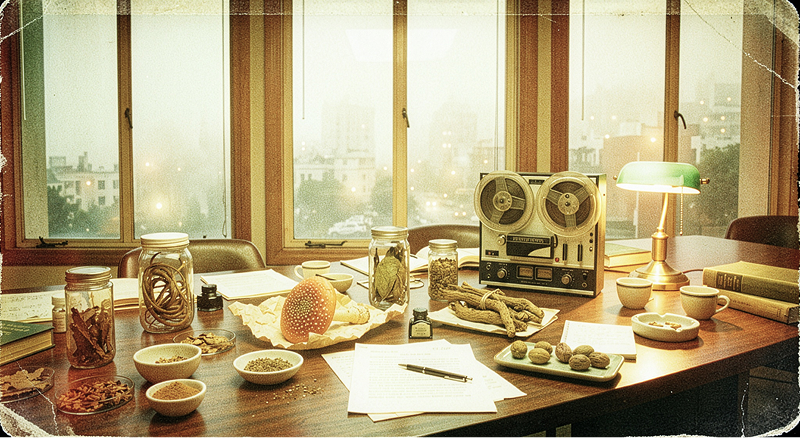
For three days in January 1967, about thirty researchers met behind closed doors in San Francisco to discuss the plants that human cultures use to alter the mind. The meeting was paid for by the United States government, it produced a single book, and then nothing happened for fifty years. That book is the reason the McKenna Academy exists, and the reason the symposium still carries its name. This is what took place, and why the silence afterwards matters as much as the meeting.
Three days in San Francisco
The symposium ran from 28 to 30 January 1967 at the San Francisco Medical Center of the University of California, now UCSF. Its full title was Ethnopharmacologic Search for Psychoactive Drugs, and it was sponsored by the Pharmacology Section of the Psychopharmacology Research Branch at the National Institute of Mental Health, within the Department of Health, Education, and Welfare. In other words, a federal agency convened and paid for a three-day meeting on visionary plants, five months before the Summer of Love took place a few miles away.
Willard C. Fleming, the Chancellor of the medical centre, opened proceedings with a welcome that wandered through the history of the campus and confessed that he had difficulty pronouncing the word ethnopharmacology. It is the sort of detail that survives only because the organisers made an unusual decision: the panel discussions after each session were recorded in full and printed in the volume alongside the papers. The result is not a tidy set of conference proceedings but a record of a conversation, arguments and asides included.
Why the meeting was called
The case for the symposium was made by Daniel H. Efron, who ran the NIMH pharmacology section and served as editor-in-chief of the proceedings. His preface sets out a straightforward argument. Drug chemistry had moved from isolating active substances in plants, to synthesising them, to inventing molecules that had never existed in nature, and somewhere in that progression it had forgotten the plants themselves. Only a fraction of the compounds of plant origin had been examined at all.
What gave the argument urgency was loss. The intrusions of civilisation, as Efron put it, were destroying both the knowledge of how these plants were used and in many cases the plants themselves. The meeting was deliberately multidisciplinary for that reason: pharmacologists, pharmacists, chemists, biochemists, psychiatrists and anthropologists were invited into one room, with the aim of exchanging information, confronting different points of view, and setting research objectives for the years ahead.
“Time is running out if we want to save this information.”
— Daniel H. Efron, Preface, 1967
Who was in the room
The volume prints an organizing committee of five: Efron, Seymour M. Farber and Roger H. L. Wilson of the host campus, Bo Holmstedt of the Karolinska Institutet in Stockholm, and Nathan S. Kline of Rockland State Hospital. Holmstedt and Kline also co-edited the proceedings. A larger conference committee under Farber handled the meeting itself, and the volume credits Holmstedt’s wife as its artist.
About thirty people were invited. Some of the names are familiar to anyone who reads in this field: Richard Evans Schultes and R. Gordon Wasson, both of the Botanical Museum at Harvard; Andrew Weil, then at Harvard Medical School; Alexander Shulgin, at that point in the pharmacology department of the host campus; Claudio Naranjo from the Universidad de Chile. Many more are not. Clellan S. Ford was an anthropologist at Yale, Carleton Gajdusek came from the National Institutes of Health, S. Henry Wassén ran the ethnographic museum in Gothenburg, and Efren Carlos del Pozo came from the Universidad Nacional de Mexico.
One frequently repeated detail is wrong. Albert Hofmann was not there. The front matter prints a letter from him instead, which is a different thing, and his name appears nowhere in the sessions or the participant list.
did you know
A Soviet academician presented at the meeting. I. I. Brekhman travelled from the Institute of Biologically Active Substances in Vladivostok to speak on psychoactive drugs used by the minor nationalities of Siberia and the Soviet Far East. This was a United States federal meeting in January 1967, which gives some sense of how seriously the organisers took the idea that the knowledge was worth having wherever it came from.
What they actually discussed
Six sessions, all but the first closing with a panel discussion printed in full. Session I was an overview of the field, chaired by Chauncey D. Leake, with Holmstedt’s historical survey, Schultes on the place of ethnobotany, del Pozo on Aztec pharmacology, and Daniel X. Freedman on the use and abuse of psychedelic drugs. Session II took kava, Piper methysticum. Session III took nutmeg, Myristica fragrans. Session IV, chaired by Holmstedt, covered South American snuffs. Session V took ayahuasca. Session VI closed on the fly agaric, Amanita muscaria, with Wasson’s paper on the mushroom and man.
That list contains a surprise. Kava occupies more of the volume than any other subject, eight contributions plus a panel, covering its function in Samoan culture, its use in the New Hebrides, its chemistry, its pharmacology and its ethnography. The meeting that is remembered as the first psychedelic conference spent more of its time on a social drink from the Pacific than on anything else. The ayahuasca session, by contrast, runs to three short papers, one of them barely a page.
The questions raised in 1967 are still open.
The Living Library holds full courses with Dennis McKenna, Wade Davis, Michael A. Coe and other leading ethnobotanists.
The book that outlived the conference
The symposium was closed. No public could attend, and no recording circulated. What the public got was the book, issued as Public Health Service Publication No. 1645 and sold by the Superintendent of Documents at the Government Printing Office for four dollars. For years that was the only way in, and for a long while afterwards it was close to unobtainable.
One of the people who found it was a teenager in Colorado. Dennis McKenna came across the volume shortly after publication, and has described it as the book that opened the world of ethnopharmacology to him, because it supplied a cultural context for these plants drawn from traditions far older and richer than anything in the popular press of the time. That encounter is the thread connecting a closed federal meeting in 1967 to the symposium series the Academy runs today. The volume was reprinted as a paperback by Raven Press in 1979, and later reissued by Synergetic Press alongside the ESPD50 research in a collector’s box set that won the James A. Duke Botanical Literature Award.
The decade that never came
Efron ended his preface with a hope: that a second meeting would follow, on the same topics, covering a much broader spectrum of problems. The intention was a follow-up roughly every ten years, so the field could keep track of itself. None was held. The War on Drugs closed the policy window that had made a federally funded meeting on visionary plants possible in the first place, and the research programme the symposium was meant to launch went quiet for a generation.
The sequel finally arrived half a century late. ESPD50 was held at Tyringham Hall in England in 2017, organised by a team led by Dennis McKenna, and ESPD55 followed at St Giles House in 2022. ESPD60 is planned for 2027, sixty years on from San Francisco and, as it happens, exactly the decade interval that was promised and never kept. The full series is described on the ESPD programme page.
did you know
The original hardcover sold for four dollars from the Government Printing Office. By the time the volume was scanned in 2009, a rare book dealer was asking roughly one hundred times that for a copy. Scarcity, rather than suppression, is what kept the founding document of ethnopharmacology out of most people’s hands for forty years.
ESPD 1967 at a Glance
Frequently Asked Questions
What was the ESPD 1967 symposium?
ESPD 1967 was a three-day scientific meeting on psychoactive plants, held in San Francisco from 28 to 30 January 1967 and sponsored by the National Institute of Mental Health. It brought together roughly thirty invited researchers from botany, chemistry, pharmacology, psychiatry and anthropology to pool what was known about the plants human cultures use to alter consciousness. It was closed to the public, and its proceedings were published as a government volume later the same year.
What does ESPD stand for?
ESPD stands for Ethnopharmacologic Search for Psychoactive Drugs, the title of the 1967 symposium and of the book that came out of it. The later meetings in the series are named for the anniversary rather than the year, so ESPD50 marks fifty years on in 2017, ESPD55 marks fifty-five in 2022, and ESPD60 marks sixty in 2027. The founding meeting is referred to by its year, ESPD 1967.
Can you still get the 1967 ESPD proceedings?
Yes, though not in its original form. The volume was published as Public Health Service Publication No. 1645 in 1967 and reprinted as a paperback by Raven Press in 1979, and both printings are long out of print. Synergetic Press has since reissued the 1967 volume alongside the ESPD50 research as a collector’s box set, which has been reprinted several times and won the James A. Duke Botanical Literature Award. Secondhand copies of the original hardcover command high prices.
Was ESPD 1967 a psychedelic conference?
Not quite, and the volume shows it. The programme covered kava, nutmeg, South American snuffs, ayahuasca and fly agaric, alongside an overview of the field, and kava took up more of the book than any other subject. The organising idea was ethnopharmacology in general, the scientific study of the drugs human communities actually use, with psychoactive plants as the common thread. Reading it as a psychedelics meeting imports a later framing that the participants themselves did not use.
Who attended the 1967 ESPD symposium?
About thirty invited participants. They included Richard Evans Schultes and R. Gordon Wasson of Harvard’s Botanical Museum, Bo Holmstedt of the Karolinska Institutet, Andrew Weil, Alexander Shulgin, Claudio Naranjo, Carleton Gajdusek, Clellan S. Ford, S. Henry Wassén, Efren Carlos del Pozo and I. I. Brekhman of Vladivostok, among others. Albert Hofmann is often listed among them but did not attend; the volume prints a letter from him in its front matter instead.
Why does ESPD 1967 still matter?
Because it set the terms the field still works in. It treated Indigenous knowledge as a serious source of scientific leads rather than as folklore, it insisted that botany, chemistry, pharmacology and anthropology had to be in the same room, and it named the discipline. It also left a warning that has aged uncomfortably well: that the knowledge and the plants were both being lost, and that time was short. Much of the research agenda it set out remains unfinished.
Why was there no ESPD symposium between 1967 and 2017?
Follow-up meetings were intended roughly every ten years, and Efron said as much in his preface. None took place. The War on Drugs closed the policy window that had allowed a federal agency to convene a meeting on visionary plants in the first place, and research in the area became difficult to fund and difficult to publish. The series resumed only in 2017, when funding, a venue and an organising team came together for ESPD50 at Tyringham Hall.
Where can I study ethnobotany and ethnopharmacology online?
The McKenna Academy Living Library carries full courses taught by working ethnobotanists, ethnopharmacologists and conservation researchers, covering plant chemistry, ethnomedicine, fieldwork ethics and the traditions these plants belong to. It is the direct continuation of the conversation the 1967 symposium began, and of the ESPD volumes that followed it. Courses can be taken at your own pace, and members also get access to the community and to new material as it is published.
Every detail in this article is taken from the published proceedings: the organizing and conference committee lists, the list of invited participants with their affiliations, Efron’s preface, the table of contents and the transcribed panel discussions. Where accounts of the symposium in circulation disagree with the volume, the volume has been followed.
Sixty years on, the search continues
The Living Library is the Academy’s online course collection, taught by the ethnobotanists, chemists and conservation researchers working in this field now. It carries forward the research agenda the 1967 symposium set out.
Join the Living LibraryFounding Member pricing · Full course library · Private community
Ethnopharmacologic Search for Psychoactive Drugs
The 1967 proceedings, reissued with the ESPD50 research as a collector’s box set · Synergetic Press


