Ethnopharmacology Field Guide · Psychedelics & Consciousness
A symbiotic revolution, in Dennis McKenna’s telling, begins with a quietly subversive idea: that the medicines we most need are not locked inside a patent or a clinical trial, but growing in the wild, waiting to renew an alliance with our species that is older than agriculture, and perhaps older than modern humans themselves.
In This Article
Dennis McKenna opens with a line from Stanislav Grof, the pioneer of LSD-assisted therapy and a founder of transpersonal psychology, who compared psychedelics’ significance for psychology to what the microscope gave biology and the telescope gave astronomy. Dennis takes the comparison further: psychedelics, he suggests, are lenses that point in two directions at once: inward, at the neural substrates of consciousness and perception, and outward, at our relationship with the living world. That double vision is the through-line of everything that follows.
The Psychedelic Renaissance Succeeded, and That’s the Problem
By Dennis’s reckoning, the psychedelic renaissance has, in the narrow sense, won. Substances dismissed a few decades ago as worthless and dangerous are now studied for PTSD, end-of-life anxiety in cancer patients, addiction, treatment-resistant depression, OCD, eating disorders, and cluster headaches. The therapeutic potential has been, in his words, grudgingly accepted by the biomedical community. He notes that MDMA and psilocybin were once expected to reach FDA approval within three to five years, though a less favorable regulatory climate has pushed a realistic timeline closer to five to ten.
Success, though, has attracted a familiar kind of attention. Venture capital, psychedelic drug companies, and what Dennis calls the biomedical-pharmaceutical-industrial complex are moving to own and control medicines many regard as a common heritage of humanity. His summary of the logic is blunt: what isn’t patented is prohibited. That raises a stack of unresolved questions: who regulates access and cost, who pays, whether insurance covers it, and whether these therapies end up available only to those who can afford them.
Then there is the deeper injustice. Psychedelic plants and fungi have been under indigenous stewardship for hundreds of thousands of years, and that stewardship has a long history of being disrespected through the misappropriation of genetic resources and traditional knowledge, the same shameful legacy of biopiracy that shadows many of our most important food and medicinal plants. As the commercial rush accelerates, Dennis asks what measures are actually being taken to acknowledge and compensate the communities who kept this knowledge alive.
“Remember — you monkeys only think you’re running this show. The plants, the fungi, and the bacteria — in fact, the entire symbiotic community of species — is what is running this show.“
— Dennis McKenna, recalling a message received from ayahuasca, 1993
Take Nature Back: The Case for Going Direct
Dennis’s answer to the commodification of psychedelics is disarmingly simple: go back to nature. Most known psychedelics remain scheduled, and that isn’t changing soon; the horizon for legal, insurance-covered psychedelic therapy is years away, with only a handful of states having loosened restrictions on substances like psilocybin. His point is that people in pain cannot wait a decade for a bureaucracy to catch up.
So the solution, he argues, is to return to the source. We don’t have to bend the knee to the FDA, the DEA, or predatory capital; instead, “we the people” can rediscover our own ancient symbiotic alliances with psychedelic plants and fungi. Those partnerships have been resident in nature for thousands, arguably millions, of years, and in his framing they are accessible and, in a sense, eager to welcome us back. This is the heart of what he calls taking nature back. It is worth reading alongside his work in ethnopharmacology, the field devoted to how cultures have long used plants as medicine.
What Symbiosis Actually Is
Symbiosis, Dennis reminds us, is a close and long-term biological association between dissimilar species, often for mutual benefit. He likes it enough to make a verb of it, to symbiose, to enter into symbiosis with another organism, and claims, with a grin, to have invented the usage. His larger biological point is genuinely radical: symbiosis, not competition, is the great engine of complexity. Organisms that symbiose together tend to evolve further than those locked in survival of the fittest.
The classic example is symbiogenesis. Between roughly 2.6 and 1.6 billion years ago, free-living microbes began to merge: anaerobic and aerobic bacteria joining forces in a process of endosymbiosis. The mitochondria that power our cells and the chloroplasts that let plants “eat light” were once independent organisms, absorbed and kept. That single evolutionary move produced the entire branching tree of complex life: plants, fungi, animals. Photosynthesis, the ability to harvest light and turn it into the molecules of life, arrived in the same deep window, and it never stopped scaling toward complexity.
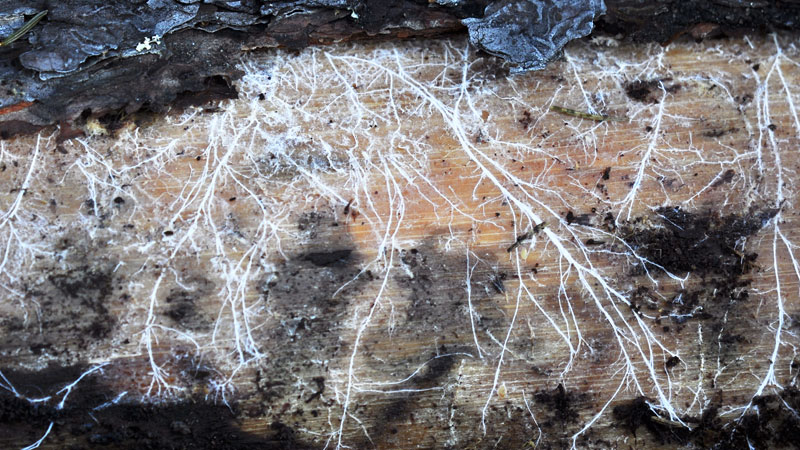
From there Dennis walks through symbiosis at every level of the living world. Pollination: flowering plants cannot complete their reproductive cycle without enlisting a third party: bee, butterfly, beetle, bat, or bird. Forest ecology: the underground fungal networks that link trees into a “wood-wide web,” research pioneered at the University of British Columbia by forest ecologist Suzanne Simard against a skeptical establishment. Insect agriculture: leafcutter ants that farm fungus on composted leaf cuttings, in a chemically-managed system involving ants, fungi, and protective bacteria all at once. And ourselves: humans are superorganisms, holobionts colonized by bacterial, viral, and fungal partners. Through fermentation and domestication, we are ourselves the managers of symbiotic species from crops to livestock to yeast.
“You Monkeys Only Think You’re Running This Show”
The line Dennis returns to came, he says, from ayahuasca in 1993: a reminder that humans only imagine they are in charge. The plants, fungi, and bacteria, the whole symbiotic community, are what actually sustain the biospheric web of life. He connects this to the Gaia hypothesis, James Lovelock’s proposal that the community of life actively modulates the planet to keep conditions within the narrow band life can tolerate: the temperature, salinity, and pH of the oceans, the composition of the atmosphere, the surface temperature. He recalls the famous reflection that, seen from the distance of the moon, the astonishing thing about Earth is that it is alive: a bright, moist, breathing thing against a dead grey foreground.
The atmosphere itself, he stresses, is a gift of photosynthesis, the main planetary process that pulls carbon dioxide out of the air and into the living bodies of plants, releasing oxygen as a byproduct. And here the argument turns grave. We are, in his phrase, the problematic primates: busily dismantling the very homeostatic systems that keep the planet habitable, and largely ignoring it at the level of policy. At some point, he warns, those balancing mechanisms will be overwhelmed.
Coevolution: How Psychedelics Shaped Us
Quoting Salvador Dalí’s quip (asked whether drugs inspired his surrealism, the painter replied that he was drugs), McKenna moves to coevolution. Our association with psychedelic plants and fungi may be old enough to have helped shape the complex human brain; he suggests we may owe part of our cognition to that long relationship. Psychedelics such as LSD, psilocybin, and DMT are, in his view, the best pharmacological model we have for transcendent or mystical experience. They are not religions, but they activate religious sensibilities, and indigenous cultures long ago built shamanism, the archaic techniques of ecstasy, to navigate the inner realms they open.
Asked about human origins directly, Dennis sketches the terrain of the Stoned Ape Hypothesis: a northern Africa of some two million years ago, well-suited to mushrooms, with cattle whose dung hosts Psilocybe cubensis, and curious hominids scanning the landscape for anything edible. They could not not notice the mushrooms, and once they did, he argues, new experiences and new possibilities followed. It is his brother Terence’s idea, which Dennis says he has since improved upon, and which he promises to unpack in full in a dedicated lecture.
The Symbiotic Revolution: Communities, Tools & Reciprocity
Because symbiosis benefits both partners (there is strength in numbers), Dennis frames it as a good evolutionary move for almost any organism, and the model for a human movement. The core challenge of our age, he says, is our estrangement from nature: the belief that we own it, that it exists only to be dominated and extracted. A symbiotic revolution is the correction; tellingly, he locates its foot soldiers not in laboratories but in communities.
Garden clubs, horticultural societies, and fungophile networks may not look revolutionary, but Dennis insists they are: full of uncredentialled yet genuinely expert people, many of them from a generation that came up in the 1960s, who know how to grow, identify, and work with these organisms. He points to open resources like Erowid for information on psychoactive plants and fungi, and to iNaturalist for distribution data, alongside easily cultivated species that pack a potent dose from a fraction of a gram.
But the revolution he wants is one of reciprocity, not extraction. The species, the indigenous knowledge, and the habitats are all under threat together, and none can be saved in isolation. He credits organizations working on exactly this seam: the Chacruna Institute for Psychedelic Plant Medicines, which champions reciprocity and psychedelic justice, and ICEERS, the International Center for Ethnobotanical Education, Research and Service. The invitation at the end is characteristically modest and radical at once: rejoin the oldest alliance on Earth, and do it in a way that gives back.
Frequently Asked Questions
What is a “symbiotic revolution”?
It is Dennis McKenna’s term for a grassroots return to direct relationship with psychedelic and medicinal plants and fungi, bypassing the patent-and-prohibit dynamics of commercialized psychedelics in favor of reciprocal, community-based stewardship rooted in how symbiosis actually drives life on Earth.
What does Dennis McKenna mean by “symbiosis”?
Symbiosis is a close, long-term biological association between dissimilar species, often for mutual benefit. Dennis argues it, not competition, is the primary engine of evolutionary complexity, from the endosymbiotic origin of complex cells to pollination, forest fungal networks, and the human microbiome.
Has the psychedelic renaissance actually succeeded?
In research terms, largely yes. Psychedelics are now seriously studied for PTSD, depression, addiction, end-of-life anxiety, and more. But Dennis cautions that clinical and insurance-covered access is still years away, and that commercialization raises unresolved questions about ownership, cost, and equity.
Why does Dennis McKenna say “what isn’t patented is prohibited”?
He uses the phrase to describe how the pharmaceutical and venture-capital model tends to favor patentable, single-molecule formulations while natural preparations remain scheduled and hard to approve, meaning the plants and fungi that are freely available in nature can stay legally off-limits.
What does “take nature back” mean?
It is Dennis’s call to go directly to the natural source of these medicines rather than waiting years for regulatory approval: rediscovering, cultivating, and responsibly using psychedelic plants and fungi within communities, while respecting indigenous stewardship and reciprocity.
How are psychedelics connected to human evolution?
Dennis proposes that our long association with psychedelic fungi may have helped shape the complex human brain. He connects this to the Stoned Ape Hypothesis, originated by his brother Terence and refined by Dennis, which links early hominids’ encounters with dung-growing psilocybin mushrooms to cognitive and cultural change.
What is the Gaia hypothesis, and how does it relate to psychedelics?
The Gaia hypothesis, proposed by James Lovelock, holds that the community of life actively regulates planetary conditions like temperature, atmosphere, and ocean chemistry to keep Earth habitable. Dennis uses it to argue that the symbiotic web of species, not humanity, truly sustains the biosphere, and that reconnecting with that web is both spiritual and ecological.
Where can I watch the full talk or learn more?
The full presentation and slides are available at mckenna.academy/living-library To go deeper into these themes, the McKenna Academy’s Living Library offers courses in ethnobotany, mycology, plant medicine, and consciousness studies taught by Dennis McKenna and Academy faculty.

Dennis McKenna, Ph.D.
Ethnopharmacologist · Founder & President, McKenna Academy
Dennis McKenna is an American ethnopharmacologist and research pharmacognosist who has spent more than four decades studying plant hallucinogens and Amazonian ethnomedicine. He earned his doctorate in botanical sciences from the University of British Columbia (1984) with research on ayahuasca, was a key investigator on the Hoasca Project, and is a founding board member of the Heffter Research Institute. He taught in the Center for Spirituality and Healing at the University of Minnesota (2001–2017), organized the landmark ESPD50 and ESPD55 symposia, and in 2019 founded the McKenna Academy of Natural Philosophy. He is the younger brother of Terence McKenna.
Go deeper in the Living Library