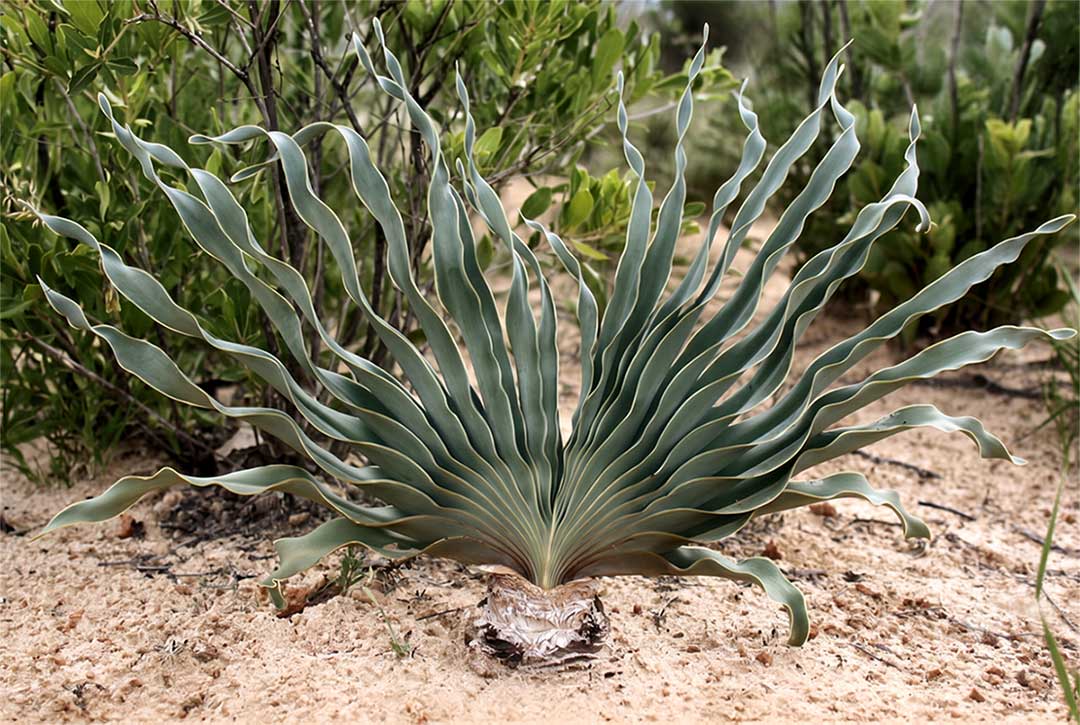
Southern Africa was long thought to hold few psychoactive plants of cultural weight — until you meet leshoma, a bulb so potent that a few papery scales can carry a person into hours of visions, or into a coma. In this field guide, medical doctor and ethnobotanist Dr. Nigel Gericke introduces Boophone disticha, the region’s leading visionary plant, drawn from his chapter in the Ethnopharmacologic Search for Psychoactive Drugs. We trace its botany, its place in San and Sotho tradition, its healing and hunting uses, its chemistry, and the narrow line that separates medicine from poison.
What Is Leshoma?
Leshoma is the South Sotho name for Boophone disticha, a striking member of the amaryllis family (Amaryllidaceae) that grows from a large bulb across temperate and tropical grassland and bushland, from Angola and Sudan down to South Africa, at altitudes reaching 2,450 metres. Each year the plant raises a single flat fan of grey-green leaves, then sheds them before sending up a dense umbel of red flowers. When the dried seed-head detaches and tumbles across the veld like a wheel up to 60 cm wide, it scatters the next generation on the wind.
The bulb — up to 20 cm long and wrapped in fire-resistant brown papery scales — is the part that matters. Those same scales are at once a remedy and a hazard. The genus name says it plainly: Boophone comes from the Greek bous (ox) and phone (death), a nod to cattle that have died browsing on the plant. Gericke’s own fascination began as a botany student and deepened in 1994, when he founded the Traditional Medicines Programme (TRAMED) at the University of Cape Town, a collaboration between researchers and traditional healers that would shape the rest of his career.
A Plant Woven Through History and the Ancestors
Across the region, leshoma is bound up with trance, divination, and the world of the ancestors. San shamans of the Kalahari are known to have entered altered states for healing in trance dances, and in 2008 a Ju/’hoansi healer in Namibia confirmed to researcher Diana Gibson that his uncle, a holder of n/um healing power, had used the bulb to enter trance and to heal. The Northern Sotho consider the plant sacred and pray beside it — with offerings of sorghum and tobacco — to reach their ancestors. Among the Basotho, carefully measured doses were once mixed into the food of circumcision initiates, said to imbue them with the qualities of their forebears and even to confer the gifts of poetry and eloquence.
The association with death runs deep. The renowned Zulu sangoma Vusamazulu Credo Mutwa told Gericke that when the spirit medium known as the Nehanda of Dande died in 1973, her body was wrapped in leshoma bulb scales before burial. In the cities, healers in Johannesburg administer decoctions to summon visions: a patient sits before a white cloth (called “bioscope”, local slang for cinema) or a mirror, and the visions that follow are read for messages from the past or glimpses of what is to come.
I have learned to try to contemplate the plant in the wild as a sacred presence connected to all Nature and to the realm of the ancestors, and to appreciate humankind’s place as inextricably part of Nature.
— Dr. Nigel Gericke, MBChB (Hons), BSc
From Healing to Hunting: Traditional Uses
In skilled hands, leshoma is medicine. The healer John Molefi Sekaja, who first taught Gericke to dose the plant, used low decoctions of the bulb scales to calm violent psychotic patients, and the plant has long been a traditional treatment for the culture-bound mental-health syndrome amafufunyana, for anxiety, and even — among Western Cape Rastafarians — as an aid to giving up alcohol. The preparation is exacting: Gericke’s own initiation involved boiling just two outer scales, drinking the cooled liquid, then clearing the system through ritual vomiting (phalaza) before settling into four or five hours of deep, tapering calm.
The dried outer scales have a gentler second life as a wound dressing — applied to cuts, burns, abscesses and boils, and reputed to draw pus and ease pain. On a 1998 expedition in the Central Kalahari, Gericke wrapped a San woman’s severely infected, scorpion-stung hand in the bulb scales; by the third day of dressings her hand had returned to normal, a vivid demonstration of the plant’s analgesic, anti-inflammatory and antimicrobial action. Far older is its role as an arrow poison: European travellers recorded it from 1774 onward, and it was a principal hunting poison of San hunter-gatherers and Khoikhoi pastoralists, the thick bulb juice dried onto arrowheads — and even onto the lances used to take springhares in their burrows.
The Chemistry and Pharmacology of the Bulb
Eleven alkaloids have been identified in the bulb of B. disticha. The major ones are buphanidrine (around 19%), undulatine, buphanisine, buphanamine and nerbowdine, alongside minor constituents including crinine, lycorine and distichamine. These compounds are the source of both the plant’s visionary effect and its danger, and their pharmacology is only beginning to be mapped. Several have shown affinity for the serotonin transporter (SERT), and extracts inhibit the dopamine and noradrenalin transporters as well as acetylcholinesterase — a profile consistent with effects on mood and the nervous system.
Animal studies point toward real therapeutic promise. Extracts have shown anxiolytic activity in mice without the over-sedation of a sedative, long-term antihypertensive effects, and clear antidepressant-like activity in repeated forced-swim stress models, where treatment normalised stress hormone and BDNF levels in the brain. Tellingly, the antidepressant effect held up against a standard comparison — while avoiding one of its drawbacks.
A Narrow Margin: Toxicity, Trade and Conservation
Leshoma carries a famously narrow therapeutic window. The classic signs of poisoning are ataxia, dizziness, impaired vision, agitation or stupor, and ultimately coma — a picture closely resembling poisoning by Datura alkaloids. The medical literature records sobering cases: three Zimbabwean teenagers hospitalised after drinking a bulb decoction for its visionary effect, and a man who, given a healer’s dose, became paranoid, drew a pistol and fired, killing one person. Fatalities from overdose are well documented. This is precisely why Gericke stresses that the plant demands long traditional training and considerable experience to prepare and dose safely — and why it “presents a grave danger to the dilettante.”
Despite this danger, leshoma is heavily traded. In one Eastern Cape survey it ranked among the most frequently sold medicinal plants, with well over a tonne moving through a single province each year, and it was stocked by a majority of traders in Johannesburg’s muthi markets. That demand has a cost: over-harvesting of wild bulbs and habitat loss have led the Red List of South African Plants to classify Boophone disticha as Declining, with populations shrinking notably in KwaZulu-Natal and Gauteng. The plant that has accompanied southern Africans for two thousand years now needs careful stewardship to remain in the wild.
Frequently Asked Questions
What is leshoma (Boophone disticha)?
Leshoma is the South Sotho name for Boophone disticha, a bulbous plant in the amaryllis family and the leading visionary plant of southern Africa. It grows from a large bulb wrapped in papery brown scales and produces a single annual fan of grey-green leaves followed by a head of red flowers. Traditional healers use carefully prepared decoctions of the bulb to induce trance and visions, to sedate patients, and to dress wounds. The same bulb is highly toxic in excess, which is why its preparation is treated as specialist knowledge.
Why is Boophone disticha called the “ox-killer” plant?
The genus name Boophone comes from the Greek words bous, meaning ox, and phone, meaning death — a reference to cattle that have died after browsing on the bulb. Its many regional names reflect the same wary respect: in Afrikaans it is gifbol (poison bulb) and malgif (mad poison), while English settlers called it the Cape poison bulb. The species name disticha simply describes the erect, fan-shaped arrangement of its leaves in a single plane.
How did the San people use leshoma?
The San have known leshoma for at least two thousand years — the Kouga mummy, a roughly 2,000-year-old San burial, was wrapped in its leaves. San shamans entered altered states for healing in trance dances, and a Ju/’hoansi healer in Namibia confirmed in 2008 that the bulb was used to enter trance and to heal. The San and Khoikhoi also relied on the bulb’s juice as a principal arrow poison for hunting, smearing the dried extract onto arrowheads and hunting lances.
How do traditional healers prepare and use leshoma?
Preparation is exacting and varies by healer. Typically only a small, carefully measured quantity of the dried outer bulb scales is boiled in water; the cooled, clear decoction is then drunk. In Gericke’s own initiation, the healer used just two scales, and afterwards had him clear his system through ritual vomiting (phalaza) before a long state of calm set in. To induce divinatory visions, urban healers may seat a patient before a white cloth (called “bioscope”) or a mirror and interpret what the patient sees. Dose is everything — too much is dangerous.
Is Boophone disticha poisonous?
Yes. Leshoma is genuinely toxic and has a narrow margin between an effective dose and a harmful one. Poisoning typically brings dizziness, unsteadiness, blurred vision, agitation or stupor, and in severe cases coma and death, with a clinical picture similar to Datura poisoning. Documented cases include hospitalised teenagers and a fatal shooting after a healer’s dose triggered acute psychosis. It should never be self-administered or used recreationally; safe use depends on extensive traditional training and experience.
Does leshoma have real therapeutic potential?
The evidence is promising but early. Laboratory and animal studies show that extracts of Boophone disticha have anxiolytic and antidepressant-like activity — in one mouse model the antidepressant effect was comparable to fluoxetine, without its anxiety-provoking side effects — and the plant has long served traditionally as a sedative for psychosis and anxiety. Its dried scales also show measurable analgesic, anti-inflammatory and antimicrobial activity as a wound dressing. There are, however, no human clinical trials yet, and the doses of alkaloids in traditional preparations have not been quantified.
What alkaloids does Boophone disticha contain?
Researchers have identified eleven alkaloids in the bulb. The major ones are buphanidrine (around 19%), undulatine, buphanisine, buphanamine and nerbowdine, with minor compounds including crinine, crinamidine, lycorine and distichamine. Several of these interact with the serotonin transporter, and whole extracts also affect dopamine and noradrenalin transporters and acetylcholinesterase — mechanisms relevant to mood and cognition. Gericke notes that none of the key alkaloids has yet been screened across the full range of nervous-system targets, leaving much still to discover.
Where can I learn more about African ethnobotany?
The McKenna Academy Living Library is built for exactly this kind of study — plants taught with their culture intact, not stripped from it. Its ethnobotany pathway includes courses on the ethnobotany of the Atlantic world and Africa, ethnobotany in the 21st century, the shamanic art of healing, and plant chemistry, taught by recognised authorities such as Wade Davis, Michael A. Coe, Bob Voeks and Dennis McKenna. You will find rigorous, context-rich teaching on how Indigenous communities understand and steward visionary and medicinal plants like leshoma.

Dr. Nigel Gericke
Medical Doctor · Ethnobotanist · Ethnopharmacologist
Dr. Nigel Gericke (MBChB Hons, BSc) is a South African medical doctor, ethnobotanist and ethnopharmacologist, and a founding member of the Association for African Medicinal Plants Standards. In 1994 he established the Traditional Medicines Programme (TRAMED) at the University of Cape Town, working directly with traditional healers. He is best known for developing Zembrin, the clinically studied standardised extract of kanna (Sceletium tortuosum).
★ Developer of Zembrin, the clinically studied kanna (Sceletium tortuosum) extract
McKenna Academy · Living Library
Go Deeper with Ethnobotany
A plant like leshoma cannot be understood apart from the people, languages and lineages that hold its knowledge — context is not a footnote, it is the medicine. The Living Library gathers the world’s leading ethnobotanists to teach plant wisdom with that context kept whole.
Ethnopharmacologic Search for Psychoactive Drugs
This article draws on Dr. Nigel Gericke’s chapter from the ESPD Vol III — part of the series edited by Dennis McKenna and published with Synergetic Press. The collector’s box set reprints the original 1967 proceedings alongside the 50-year anniversary research.
Hardback editions · Learn about ESPD50 & ESPD55 →