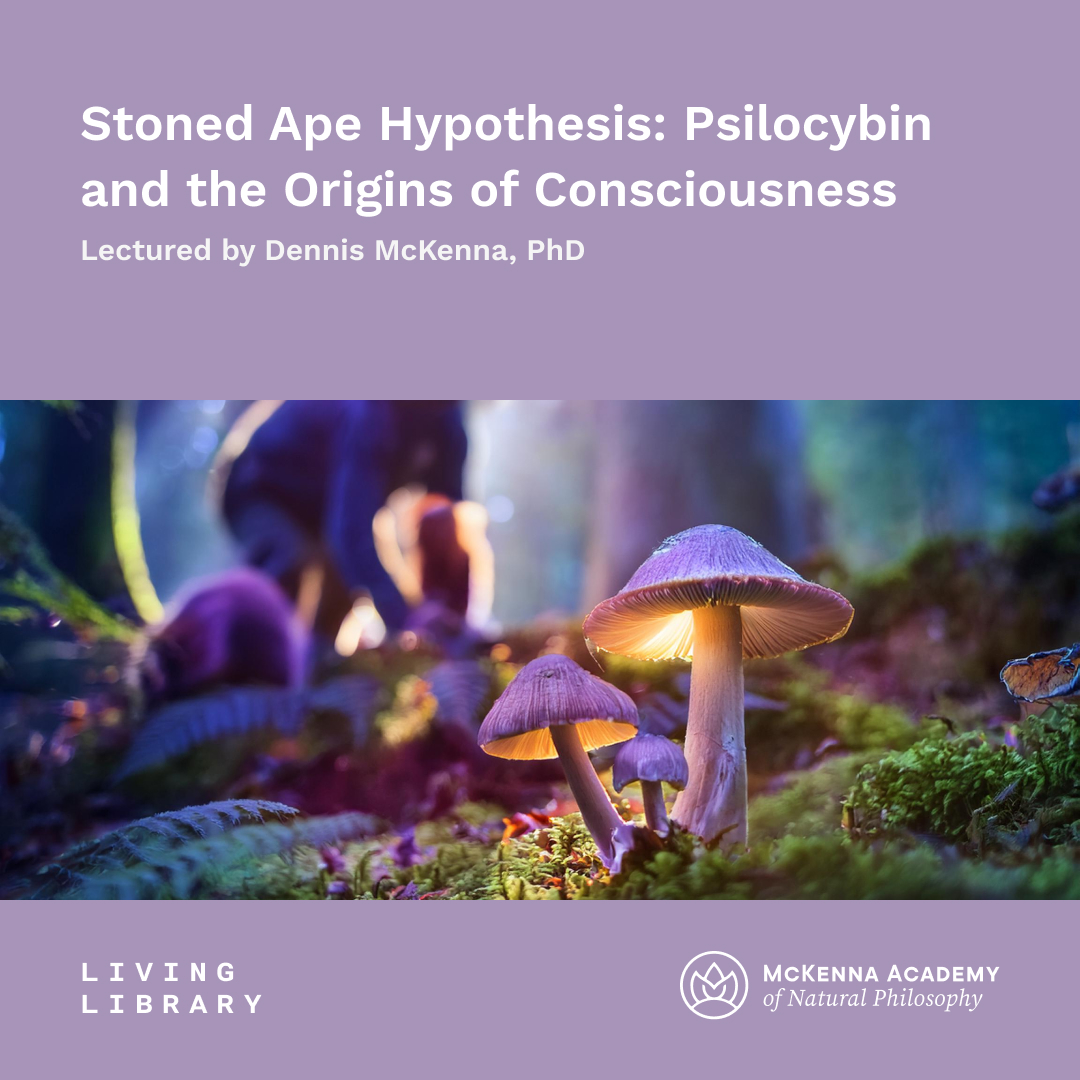
Lectured by Dennis Mckenna
How did the human mind leap from primate cognition to complex symbolic language and self‑awareness? This interdisciplinary course revisits Terence McKenna’s Food of the Gods and brings the Stoned Ape Hypothesis into the 21st century by integrating contemporary mycology, paleontology, neuro‑ecology, epigenetics, and evolutionary genetics. Students survey Psilocybe ecology with a visual overview of its molecular identity, fungal phylogeny, and documented examples of host‑altering strategies.
Case studies examine fungal behavioral manipulation – Cordyceps (notably Ophiocordyceps and the “zombie ant” phenomenon) – to illustrate how fungal chemistry can alter animal nervous systems and promote spore dispersal. The syllabus evaluates ecological scenarios for early hominid exposure to psychoactive fungi and tests proposed mechanisms – neuroplasticity, synesthesia, and horizontal gene transfer – that could plausibly accelerate cognitive change. Students will learn to evaluate psilocybin’s ecological and neurobiological significance and to distinguish testable biological models from historical speculation. Note: ethical, legal, and safety considerations are integral to the curriculum.
“Entomopathogenic fungi routinely kill their hosts before releasing infectious spores, but a few species keep insects alive while sporulating, which enhances dispersal.” “Here we report the discovery through metabolomics of the plant‑associated amphetamine, cathinone, in four Massospora cicadina‑infected periodical cicada populations, and a mushroom‑associated tryptamine, psilocybin, in annual cicadas infected with Massospora species.”
Key Learning Outcomes
- Understand the botanical context and proposed ecological role of psilocybin, with a visual overview of its molecular identity.
- Analyze the fossil record and genetic history of fungi to interpret survival strategies and deep phylogeny.
- Evaluate mechanisms of horizontal gene transfer and epigenetic regulation as potential drivers of rapid evolutionary change.
- Critically assess the Stoned Ape Hypothesis using modern neuroscience, including neuroplasticity, synesthesia, and neocortical reorganization.
- Analyze documented examples of fungal behavioral manipulation, including Cordyceps, and evaluate how host‑altering strategies inform ecological and evolutionary models relevant to hominid exposure.
- Synthesize interdisciplinary evidence to distinguish testable biological mechanisms from historical or speculative claims.
Suitable audiences
- Undergraduates in anthropology, biology, cognitive science.
- Graduate students pursuing interdisciplinary research or seminars.
- Lifelong learners and continuing‑education participants seeking evidence‑based inquiry.
- Interdisciplinary scholars in history of science, religion, and cultural studies.
- Artists, writers, and performers exploring perception, ritual and consciousness.
- Science communicators and educators seeking a research‑grounded treatment of a provocative evolutionary idea.
Case Study: Cordyceps and the “zombie ant” phenomenon – Examines Ophiocordyceps infection, host manipulation, and life‑cycle strategies as a model for how fungal metabolites can reprogram insect behavior and promote spore dispersal; used to discuss neural targets, chemical ecology, metabolomic evidence, epigenetic and gene‑transfer considerations, and fitness consequences.